
Organizing with brain-based challenges
I completed a certificate from NAPO University that makes me a Brain-Based Conditions Specialist. What does that mean exactly? NAPO uses “brain-based conditions” as an umbrella term to refer to “anything that causes a person to have ongoing difficulty or challenging differences with cognition, emotion, socialization, or behavior.” So this means that I can better serve clients who have ADHD, autism, anxiety, depression, dementia, a stroke, a TBI… Basically, anything that would interfere with executive functioning.

I wanted better training for a few reasons. Some people in my household are neurodivergent (perhaps a better term would be that we are neurodiverse); among other things, I am a Highly Sensitive Person, and one of my kids has a diagnosis of ADHD. I know that not every brain works the same! I want to understand better so that I can keep improving the services I provide. One thing you have to know is that…
Clutter isn’t laziness – it’s overload.
I listened to an episode of the podcast Even the Dog has ADHD, with my KonMari® colleague Caroline Thor as a guest. She said that “having neurodivergent minds means our environment isn’t just background noise – it’s our whole nervous system.” I can absolutely relate to that! There is a feedback loop between my outer environment and my inner world; they mirror each other. I need a calm environment to fully relax, and likewise, inner turmoil will create a messy environment.
Many people get an ADHD or autism diagnosis as adults, especially women. And then there’s the brain fog of perimenopause! If you are dealing with working memory limits, task paralysis, decision fatigue, problems with executive function, or neurodivergence in general, you know exactly what I mean.
I love working with clients who are neurodiverse, even if you don’t have an official diagnosis. I help you find solutions that work for you, to help you regain control of your home and make day-to-day living easier going forward. It could be as simple as body doubling and accountability, or more complex targeted solutions. You can book a complimentary consultation to find out more.

Hi there! I’m Amélie, a professional home organizer in San Antonio, Texas. I help people like you declutter their home, organize their belongings, and simplify their life. I love cleaning out a closet and removing a carload of donations from a home! My goal is to help you create a functional space that will make your life easier and more peaceful.
Interested? Check out my personalized services or book your complimentary consultation!
DOOM piles
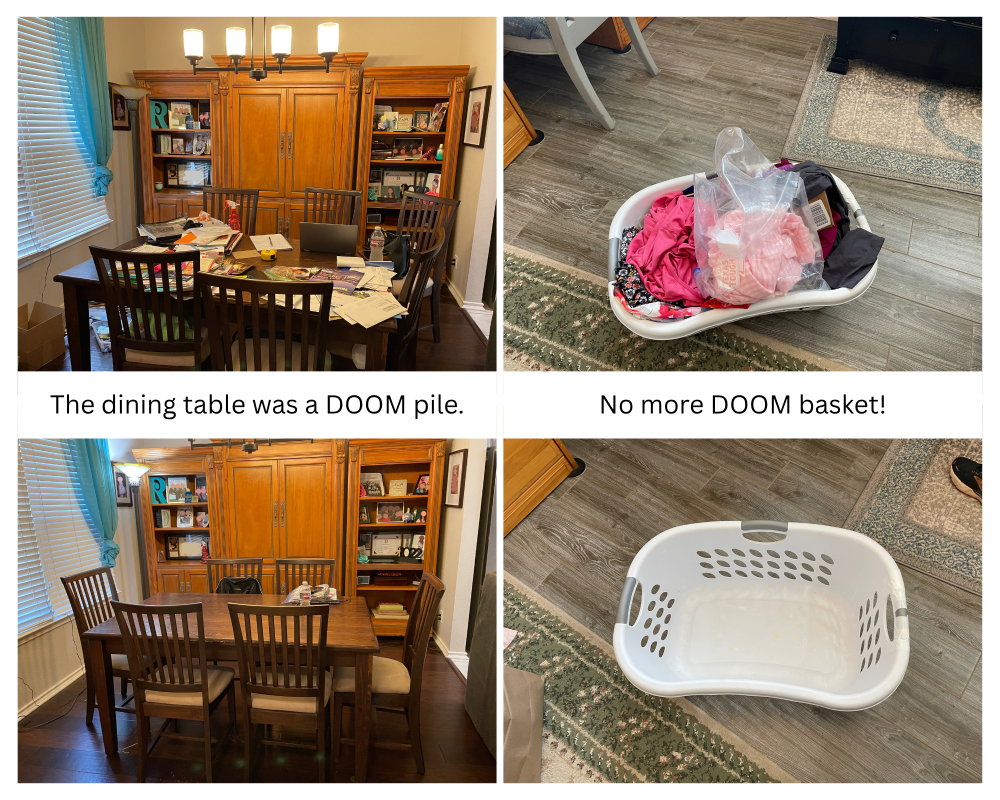
Have you heard of DOOM boxes or DOOM piles? The acronym stands for “Didn’t Organize, Only Moved.” It does a good job at conveying the feeling that these piles of stuff have upon us! Doom piles are typically piles of clutter that are gathered up and stashed out of sight before company arrives, then often remain where they were hidden instead of being dealt with. (This reminds me of Andy Warhol’s time capsules, but without the deliberate curation.) By extension, doom piles also refer to piles of clutter that accumulate over time anywhere in a house, even if they don’t move.
A doom pile often forms so slowly that you don't notice it. It's little bits and bobs of clutter that aren't dealt with in a timely fashion, so they just sit there. Typically, it forms because making a decision about an item takes more mental energy than just dumping it on top of a pile. After a while, a sort of clutter blindness sets in: our brain stops seeing them, which makes us even less motivated to deal with them. But they still drain our energy, and the pile starts to feel insurmountable. If we stash the clutter out of sight when company comes over, we are even less likely to deal with it later on! I have helped many clients deal with such piles, boxes, bins, and bags of random items they had stashed away.
Conversely, some doom piles can form all at once. For example, I helped a client deal with an entire doom closet in which everything had been stashed when they redid the floors in their house - then they simply never got around to taking the things out of the closet again, because it was too overwhelming.

Doom piles represent unmade decisions and unfinished projects, and the more they build up, the more overwhelming they become. It's hard to focus when this pile, which is really a to-do pile, is in the way! It can also negatively affect our confidence because we may think less of ourselves for not being able to deal with it or for not having a tidy, company-ready house.
Studies show that living in a cluttered environment increases our levels of the stress hormone cortisol, and this is especially true for women (more on that here). Even if we don't consciously register clutter, or choose not to deal with it, our mind still perceives it as an irritant, and it will drain our energy.
Dealing with doom piles
It's important to deal with our things! We deserve a nice, peaceful environment to live in. It helps our home function better, it helps us feel better, and it can even save us money by ensuring we don't misplace important items in the doom pile and end up buying duplicates. Keep in mind, too, that cleaning is easier without the piles; otherwise, we can dust or vacuum around items, but we can never actually clean an area properly if it is cluttered.
The best way to tackle a doom pile is to be mentally prepared to deal with the items - set a timer for 15 minutes and see what you can accomplish in that time. You can put on some music if it helps you. Create clear categories as you go so that you know how to deal with items you find. Examples would include "trash/recycle", for things that will obviously be discarded; "relocate", for items you want to keep and that actually belong elsewhere (put them in a basket and then redistribute them when the timer goes off); "donate"; or "act on" (I'm thinking mainly of important papers you might come across, or maybe a broken item you want to repair). However, one category of items may be the most important: "decide". This is for things that came into your life and that you haven't made the conscious decision to keep, yet you haven't discarded them either. This is what I mean by unmade decisions: you need to decide if you actually want to own and care for that item, and if so, where it will live! This is the toughest part because it requires actual decision-making.
If even making these categories as you go is overwhelming, consider the Doom Diamond method, in which you only make four categories (representing the four points of a diamond figure): trash / action / items with a home / items without a home. Throw away the trash, take the action, return items to their home, then… make those decisions about items without a home.
Preventing doom piles when possible
A good way to avoid doom piles is the one-minute rule: if it takes less than one minute to do something, just do it now instead of putting it off. Corollary: when handling an item, don't put it down - put it away. I also recommend doing a reset every evening as well as setting aside some time weekly to deal with items that have come in and started to pile up. Make sure you deal with your mail, permission slips from school, etc., at least weekly.
Notice where things tend to pile up and see if you can set up systems to help you with those specific areas. For example, maybe you could use a tray on which to drop your keys and the mail near the front door, or a shoe rack in the garage. I'm a big fan of having a landing zone near your front door, which is also useful for things that need to go back out of the house (packages to return, library books, etc.). And make the conscious decision to reduce influx at the source: unsubscribe from unwanted mail, refuse freebies that you are not excited about... And always think about where any new item will go before acquiring it.
Hi there! I’m Amélie, a professional home organizer in San Antonio, Texas. I help people like you declutter their home, organize their belongings, and simplify their life. I love cleaning out a closet and removing a carload of donations from a home! My goal is to help you create a functional space that will make your life easier and more peaceful.
Interested? Check out my personalized services or book your complimentary consultation!
Storing socks
This isn’t a real blog post. It’s an inevitable follow-up to my post about simplifying. I want to address a question I get from friends and clients alike, about how to store socks. Can you fold them in such a way that they will stay together? Is it okay to roll them one onto the other or to tie them together? As is the case with many such organizing questions, my answer is: It depends.
The first thing to take into consideration is how you wash and dry your socks. Personally, I do not use the dryer on my clothes (linens, yes, but clothes, no). So once I have clean but damp socks, I smooth them out and hang them on a clothing rack to dry. This means that they dry in a nice, smooth shape, and are then very “docile” about being folded and staying that way.
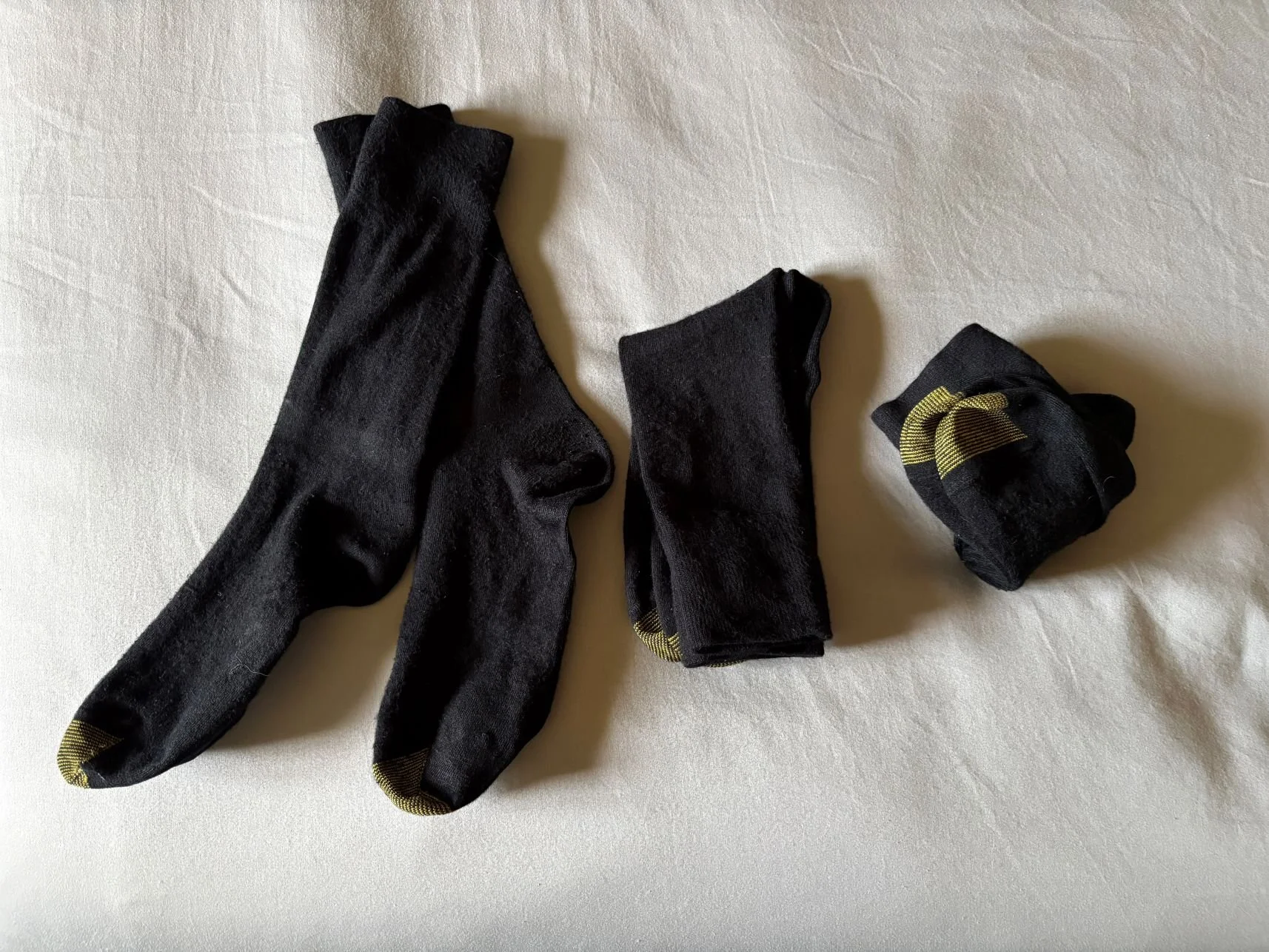
Am I saying that this is how you must wash socks? NO! Many people do not have the time or inclination to hang their clothes to dry and they much prefer using a dryer. That’s fine, but it does mean that your socks will dry with a more crooked or unpredictable shape, so they will be much harder to fold and may not stay neatly folded no matter how hard you try – you’re not doing anything wrong, you just can’t achieve the same results with socks that have been in the dryer. This is the case with many of the homes in which I work, and in those cases, I will “potato” the socks, meaning fold the top of one over the other to keep the pair together in the drawer. (I do not recommend tying them together at all.)
To be clear, the downside of this method is that it causes more strain on the elastic, making the socks break down more quickly. Plus, fabric will take the shape it had when it was drying, so with this method, it is possible that the socks will be less comfortable. Folding is the ideal way to store socks, but I do understand that it is not possible for everyone.
Bottom line: If the way you are currently washing and storing socks works for you, keep doing it. If there is something you would like to improve, let’s figure out how to tweak your system so that it works for you.
Bonus tips: If pairing socks is a pain point for you, try doing it mindlessly as you are watching television. Or have your kids do it! Another tip is to just get sets of matching socks and use a different one for each member of the household. Now the only question will be how to spend the extra time you’ll have!
Bonus bonus tip: Washing smaller loads and not using the dryer seem to be the keys to not ending up with orphaned socks.
Hi there! I’m Amélie, a professional home organizer in San Antonio, Texas. I help people like you declutter their home, organize their belongings, and simplify their life. I love cleaning out a closet and removing a carload of donations from a home! My goal is to help you create a functional space that will make your life easier and more peaceful.
Interested? Check out my personalized services or book your complimentary consultation!
Simplify
You know how there are some concepts that seem obvious if you’re very familiar with them, but to someone else, those concepts are not at all clear? I’ve had that experience recently when saying “less is more” and I was reminded that some things need explaining. I am going to use some client examples in this post, and I want to make it *abundantly clear* that I would never shame anyone; I am using these examples precisely because *they are so relatable*.
Some people have a lot of clothes. So many clothes that the baskets never empty, the clothes never all get put away, and there are always piles of stuff in the laundry room. Most often, these people feel overwhelmed by their laundry. And all too often, their reasoning is that since they have so much trouble finding clean clothes and putting together an outfit each day, the solution must be that they need *more* clothes. They are very taken aback when I tell them that the solution is actually that they need to *get rid of* a lot of clothes!
The shortest, least complicated way to get dressed is to have fewer options in our closet.
Shannon Leyko
Let’s take the example of socks. I worked with a not-atypical client who had three drawers full of socks in her closet, plus a few bins of orphaned socks elsewhere in the house. The drawers had the intention of order (lights, darks, and hosiery), but everything was pell-mell inside them, and there were many orphaned socks and strays in the wrong places, along with some mismatched socks paired together out of desperation. They had taken over too much space and were a thorn in my client’s side each day because it was so hard for her to find what she wanted!
Now, how many socks does one person need? It depends. I mean, I would say that since there are different seasons, it is absolutely appropriate to have wool socks that you only wear in the winter and cotton socks for the summer. Life also presents different types of occasions, so sure, you might need knee-high stockings, black dress socks, white crew socks, ankle sports socks, and a pair of ugly Christmas socks thrown in for good measure. I’m all for variety!
Here’s what happened with this client: Even when I pointed out socks with holes or stains, my client did not want to get rid of them or thought she would need to replace them, because she was in a scarcity mindset. The remedy was easy, if a bit tedious: sort through all the socks, pair them up properly, then organize them by type/length/color. From that point on, not only were they easy to find, but she could see what she had at a glance! At the beginning of the session, she was afraid that she couldn’t get rid of any knee-high stockings, and that was because she genuinely couldn’t always find a pair when she needed one. But once we were done, she had enough to wear a different pair every day for almost three weeks if she had wanted to, and that is when she was able to let go of the excess.
Order allowed her to simplify, and simplifying made her life easier.
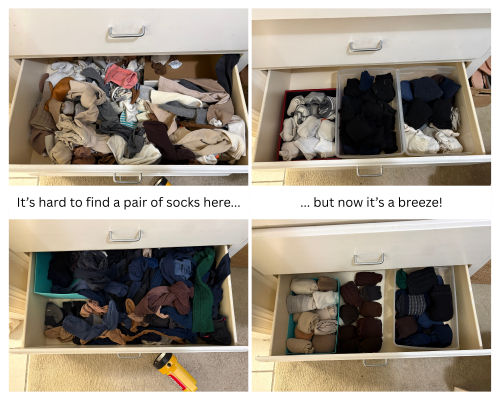

Let’s use another example inspired by a different client. Imagine doing a load of laundry and ending up with (among other things) 43 socks; after putting some order in things, you determine that you have 11 orphans and 16 pairs, each of them different. Now imagine instead doing a load of laundry and ending up with 14 socks, comprised of 7 pairs, 5 of which are identical. Isn’t sorting (and putting away) the second load so much easier? The way you get there is by having fewer socks, doing a load every week, and buying bundles of identical pairs whenever possible. David Tennant gets it!
And when this client realized that even if we did match all the orphaned socks that had accumulated, the drawer wasn’t spacious enough for them, her reaction was to say that she would need to purchase more storage. And I said that actually, her storage was fine, it was just that she had too many socks! It just felt like it wasn’t enough because they didn’t get put away properly once they were clean, and again, that’s easier to do with fewer socks.
Because here’s the thing: The fewer items you have to manage, the less energy it will take from you – and therefore the more energy you have for important things. You can pare down to the essentials, switch to only one sock color, limit the number of special-occasion socks, and simplify both your closet and your life.
By the way, it’s easier to keep up than it is to catch up. That’s why clients hire me to help them catch up – then they are set up for success!
Here are some tips for success: It’s not about how many socks you can fit in your space or how many you could afford to buy; it’s about how many will make your life more manageable. To translate this more broadly, build a system that meets you where you are today. Which routines feel easy? Which routines (or spaces) do not serve you? What drains you and what would you need to feel better about it?
Hi there! I’m Amélie, a professional home organizer in San Antonio, Texas. I help people like you declutter their home, organize their belongings, and simplify their life. I love cleaning out a closet and removing a carload of donations from a home! My goal is to help you create a functional space that will make your life easier and more peaceful.
Interested? Check out my personalized services or book your complimentary consultation!
What to expect when working with a professional organizer
Are you overwhelmed by clutter in your home or workspace? Do you find it challenging to keep things organized and in order? If so, hiring a professional organizer may be the perfect solution for you – getting organized is an investment in your home and in yourself. In this blog post, I’ll walk you through what to expect when working with a professional organizer, helping you to understand the process and how it can transform your space.
1. Choosing your organizer
Just like you wouldn’t hire an electrician or financial planner without checking their references, you’ll want to make sure you hire an insured, trained professional when it comes to organizing your home. Members of NAPO abide by a code of ethics and have received education in the field; they offer professional, confidential, and non-judgmental services tailored to your needs. Likewise, KonMari® Consultants have completed supervised training and have been certified by Marie Kondo. Amélie is one of only a handful of people in the world to be a member of both organizations! If you suffer from specific challenges, you might want to turn to the ICD. You can also look up an organizer’s reviews.
What to consider:
- What type of qualifications are important to you?
- Is there a personality type that meshes best with yours?
- What style of organizing are you most drawn to?
- Can you form an idea of who this organizer is based on their website or social media presence?
2. Initial consultation
Before any organizing begins, a professional organizer will typically schedule an initial consultation. This meeting (which can be on the phone, online, or in person) allows you to discuss your challenges, goals, and expectations. During this time, the organizer will assess the scope of your project and discuss potential strategies, timelines, and pricing.
What to prepare:
- Have a list of your organizing challenges.
- Identify any specific areas you want to focus on.
- Be ready to discuss your goals and vision for the space.
Photo by Sarah Brown for Unsplash.
3. Decluttering process
The first essential step in organizing is decluttering. Your professional organizer will guide you through deciding what to keep, donate, or discard. This can be an emotional process, so having an expert by your side can provide motivation, guidance, and support – though the final decision is always yours. Plus, an organizer like me can remove donations from your home and drop them off where they will be used, greatly simplifying your to-do list!
Key tips:
- Do NOT tidy up before your organizer gets there!
- Prepare some boxes or sturdy bags for carrying donations.
- Be honest about why you’re keeping certain items; understand that it’s okay to let go of things that no longer serve you.
- Embrace the feeling of liberation that comes with decluttering.
4. Hands-on organization
Once decluttering is complete, the fun part begins: organizing! Your professional organizer will work with you to create functional and aesthetically pleasing systems for storing your belongings. This might include everything from labeling bins to rearranging furniture and buying organizing supplies.
What to expect:
- Selecting organizing supplies based on your needs and budget.
- Using space-efficient storage solutions, including racks, bins, and specialty organizers.
- Customized systems that are easy for you to maintain.
5. Education and empowerment
A good professional organizer will not only help you organize your space but will also empower you with skills and strategies to maintain the organization over time. They’ll teach you how to create effective organizing systems that work for your specific habits and lifestyle.
Learning components:
- Practical tips for daily maintenance.
- Strategies for preventing clutter accumulation in the future.
- Recommendations for ongoing organization systems.

Photo by Luisa Brimble for Unsplash.
6. Follow-up support
Many organizers offer follow-up support and check-ins to ensure you’re still on track. This could include additional sessions to tackle new areas or to refine existing systems. Having ongoing support helps maintain motivation and accountability.
What you might experience:
- Scheduled follow-up sessions to reassess and adjust your organizing system or reset things.
- Resources for ongoing support, such as articles, workshops, or online communities.
- Encouragement to keep the momentum going after the initial project.
7. Realistic expectations
Remember that organizing is a process, not a one-time fix. It may take time to see the full results, depending on the extent of the work and your ability (as well as that of other household members!) to adjust to new systems. Professional organizers understand this and will work at a pace that feels comfortable for you.
Important points to consider:
- Be patient with yourself and the process.
- Celebrate small achievements along the way.
- Understand that developing new habits takes time.
Conclusion
Working with a professional organizer can be a rewarding experience that transforms your space and your mindset towards organization. By understanding what to expect, you can embark on this journey with confidence. From initial consultations to ongoing support, a professional organizer is dedicated to helping you create a functional, serene, and clutter-free environment.
Ready to take the first step? Reach out today and begin the process of reclaiming your space!
Hi there! I’m Amélie, a professional home organizer in San Antonio, Texas. I help people like you declutter their home, organize their belongings, and simplify their life. I love cleaning out a closet and removing a carload of donations from a home! My goal is to help you create a functional space that will make your life easier and more peaceful.
Interested? Check out my personalized services or book your complimentary consultation!
How to get unstuck
It’s very common to get so overwhelmed by a messy, cluttered space that we get stuck! We get analysis paralysis and freeze because we don’t know what the next step is, and the whole task seems like too much. I know it happens to my clients a lot, and it sometimes happens to me, too! People who find themselves in that situation will often just give up – they will ignore the space, which means that it will stay the same or even get worse, but it still occupies a lot of mental bandwidth for them. So, what can we do to get unstuck?
If you feel so overwhelmed by a task that you are unable to start it, it’s because the first step isn’t small enough. So break the task down into smaller chunks to get a better handle on it!

Here is one simple tip I swear by: Pick a corner and start working from there. Maybe I start by picking things up off the floor so that I have room to walk around without tripping. Then I’ll pick a corner of the room and work my way clockwise until it’s done. If there are piles of boxes, I just do one box at a time.
You can also do this in small chunks of time! Obviously, when I go to a client’s home, I might be working for hours at a time. But you can set a timer and do this for 15 minutes, a little bit every day, and you will definitely see progress! The important thing is to keep the momentum going.
Another important point is that you need to define the task. Figure out what actions you need to take, or what your options might be for each item, before you even start.

Let’s say we are working through a pile pf papers. Your options might look like “shred,” “recycle,” “file with taxes,” “file with other important papers,” “keep only until a certain date,” or “act on it.” While you can’t necessarily account for everything, you’ll at least know roughly what to expect and can set yourself up accordingly with a paper bag to hold paper to be shredded, a recycling bin, and a filing system.
If the task is to unpack after a move or to sort through boxes of items that belonged to a deceased loved one, then you know you will need to open boxes and make decisions about the items inside. Keep or discard? And if you are keeping the item, where will you store it? Take it one box at a time.
Finally, get support when you need it.
This could look like having a friend or relative help you, or you can consider hiring a professional like myself or one of my colleagues. Home organizers love to help you solve those problems!
Hi there! I’m Amélie, a professional home organizer in San Antonio, Texas. I help people like you declutter their home, organize their belongings, and simplify their life. I love cleaning out a closet and removing a carload of donations from a home! My goal is to help you create a functional space that will make your life easier and more peaceful.
Interested? Check out my personalized services or book your complimentary consultation!
What should I do with my stuff... in San Antonio?
I have seen this scenario a hundred times: you have a pile of stuff you want to get rid of, but you don’t have a plan. So, the pile doesn’t move and just becomes part of your décor. Sounds familiar? Let me help!
As a professional home organizer, I take my clients’ donations away after a session if they wish. But for everyone else in San Antonio, Texas, here are some resources where you can drop off your donations. Leave a comment if you have a favorite that I forgot! (Please do not suggest charities that only accept monetary donations or brand-new items straight from their wish list, as that is not the point of this post. This is for in-kind donations of gently used items.)
I have separated the sections below by theme; feel free to use the Find function (Ctrl + F ) to find a specific item, or just scroll through to read. There are options for donating, selling, or recycling responsibly.
Consider donating to women’s/children’s shelters, homeless shelters or other charities, such as…
- Haven for Hope (items for adults and children, household goods)
- Family Violence Prevention Services (clothes for women and babies, diapers, toiletries, household items)
- Child Safe (diapers, wipes, school supplies, gift cards)
- Margaret’s Place (toiletries, diapers, clothes, winter coats, school supplies, board games)
- Children Matter (toys, art supplies, household items)
- The Hope Center (food, clothing, household goods)
- San Antonio Ministries (toiletries, non-perishable snacks)
- I Support the Girls (bras, period products)
- Volunteer Services Council of TCID (coats, shoes, luggage, crafts and activities)
- The Strong Foundation (homeless families need all sorts of items, including appliances)
- VetStrong (formerly homeless veterans needs furniture and household goods, including mattresses!)
- Homeless shelters in San Antonio (clothes, toiletries, food)
- Boysville Auxiliary Thrift Store is a non-profit (accepts clothes and household items; can pick up furniture)
- Zappos will let you print a free shipping label for gently used shoes and clothes; items are donated to Soles4Souls or recycled
- Your local church or community center might be interested as well
For more specific items:
- Animal shelters (pet items, pet food, old towels and blankets)
- Food pantries for non-perishables (Goodwill has drop-offs)
- Dress for Success (work clothes)
- The Bra Recyclers (will donate or recycle bras)
- Brides Across America (wedding dresses up to 3 years old)
- Project MEND (medical equipment)
- Street2Feet (gently used athletic shoes, socks, and apparel)
- Lions Club or most optometrists (used eyeglasses, including prescription eyewear)
- Local daycares, schools, and libraries (toys, books, change of clothes)
- Local first responders (stuffed animals)
- National Crayon Recycle Program (crayons)
- LEGO® Replay (LEGO® bricks)
- The Book Rescuers (books, including textbooks!)
- Nationwide Trophy Recycling Program (trophies)
- Coinstar kiosks, choose your charity (coins, including foreign currency to UNICEF Change for Good)
- Spare Parts (arts and craft supplies)
- St. Jude Children’s Research Hospital (donate gift cards, even partially used)
- Resupply will pick up furniture
- World Computer Exchange (old computers)
- Computers With Causes (old computers and equipment)
- The Tech Take Back Box (electronics)
- Fur the Animals (old fur coats)
- Freecycle (post what you have, or search for “ISO [your item]”)
For household goods and clothes and with possible pickup:
- Goodwill
- AMVETS
- Habitat for Humanity (some appliances, furniture, home décor, light fixtures, electronics, rugs, patio furniture, etc.)
- Give Back Box (to mail in small items)
- Or use Donation Town to schedule a pick-up with a local charity
To make a bit of extra cash in person:
- Yard sale
- Nextdoor, Facebook Marketplace, community Facebook group
- Half-Price Books (books, magazines, music, movies, board games)
- Clothes Mentor (seasonal women’s clothes)
- Too Good to Be Threw (high-end fashion and furniture)
- H&M (any clothes or even fabric for recycling – you receive a coupon for your next purchase)
- DSW will give gently used shoes to Soles 4 Souls; you get 50 points per pair
- Bricks & Minifigs (LEGO®)
- My Comic Shop buyer associates (comic books)
- Lone Star Coins (gold and silver, including coins, jewelry, silverware; collectible bills as well)
- Play It Again (sporting equipment)
To make a bit of extra cash online:
- eBay.com (just about anything)
- Gazelle.com (cellphones, tablets)
- Amazon Trade-in (tech, cell phones, gaming)
- ThredUp (women and children’s clothes)
- The Real Real (designer clothes and accessories)
- The TakeBack Bag for recycling clothes
- Replacements.com buys (and sells) china, crystal, and silverware
To pay for a pick-up:
- 1-800-GOT-JUNK (my clients get a 10% discount!)
Resources for proper disposal/recycling:
- Batteries Plus (batteries, light bulbs, small electronics)
- Best Buy (batteries, electronics)
- Staples (office supplies, tech, etc.)
- Drugstores (expired medications)
- Office Depot (drop-off shredding) or Shred Nations (mobile shredding)
- If you live within city limits, recycling centers will take household hazardous waste and bulk waste
- Earth 911 (hazardous materials, etc.)
- Terracycle (hazardous materials, etc., but also various packaging such as cosmetics or cleaning products)
- Green Disk (electronic media recycling)
- Target (annual car seat trade-in event; you get 20% off towards buying select baby gear)
- In San Antonio, Goodwill recycles fabric too!
Hi there! I’m Amélie, a professional home organizer in San Antonio, Texas. I help people like you declutter their home, organize their belongings, and simplify their life. I love cleaning out a closet and removing a carload of donations from a home! My goal is to help you create a functional space that will make your life easier and more peaceful.
Interested? Check out my personalized services or book your complimentary consultation!
Care tasks are neutral
I recently listened to a really great episode of the podcast Ten Percent Happier, titled Messiness Is Not a Moral Failing, with therapist KC Davis (of Struggle Care) as a guest. I’d like to give you some takeaways from the episode as well as my opinion on it.

KC Davis Author Photo 2022 © Julie Soefer
First, let’s define an important term: “care tasks.” Care tasks are things that we need to do to maintain our home/ourselves, but they are never finished in that they are cyclical. For example, I could wash all the dishes and be done with that task (until the next meal, that is), but while I did that, the kids made a mess with their toys. If I pick it up, there will still be the bathroom to clean and the laundry to do, and while I was taking care of that, the dust was settling in the bedroom and the grass was getting long outside… You see where I’m going with this? There’s always something to be done, and that’s alright – we have to learn to live with that.
So, care tasks should be neutral. What I mean by that, what this whole episode was about, is that we often feel guilty or ashamed for not doing enough of those tasks, or we force ourselves to do them a certain way to live up to imaginary standards. Not doing the dishes doesn’t make one a bad person, just like doing all of them doesn’t make one more virtuous. If this is a pain point for you, ask yourself why you want the dishes done in the first place. Strictly speaking, what you *need* are enough clean dishes to eat and prepare meals; that’s the basic health and safety issue. Perhaps the sight of dirty dishes also bothers you, and you would be more comfortable without them in the way. Some people are happier cleaning as they go, so that they never have dirty dishes pile up; other people will be stressed out by that and will be happier setting aside a chunk of time to tackle everything (or at least the essentials) at the end of the day. The trick is to stop passing judgement on ourselves for having dirty dishes in the first place, and to learn to be at peace with whatever system we choose for cleaning dishes. If it’s the sight of dirty dishes in the sink that bothers you, but you can’t clean as you go for whatever reason, then we can come up with other solutions, like storing dirty dishes in the dishwasher, or even rinsing dishes and storing them in a drying rack until they can be washed properly, thus freeing up your sink in the meantime. The point is to reassess your priorities and put your energy where it will have the most impact.
As another example, so many people feel ashamed of their clothes chair, but I think you should embrace it if it’s functional! Remember that you don’t exist to serve your space, but your space exists to serve you. So we need to create systems that are functional for *you*, even if that’s not the way you were taught that things *should* be. I have a client who stores her young daughter’s clothes in the closet of the main bedroom, because that’s just where her daughter gets dressed anyway and that’s what works for them. I have a friend who doesn't fold any clothes for her family of 6 because she absolutely hates folding, and everyone still has clean clothes to wear every day (taken from a bin or a hanger). Sometimes there can also be a problem to solve, like if your dirty clothes always end up on the floor of the bathroom instead of in the hamper in the bedroom. Then I’d say to simply put the hamper in the bathroom (and even consider a lidless hamper, because for some people, removing that little obstacle can make all the difference).
Any change that we want to bring to our life should come from a place of caring for ourselves and should bring joy to our life. Take the pressure off and know that you are worthy of resting! For me, cooking is like that – I don’t necessarily enjoy the act of cooking, but I do like eating well, so cooking most of my own food improves my life in that way. My “hack” is that I always cook enough food to have leftovers for a second meal. So I put in about the same effort, but reap twice the rewards, and because I don’t mind leftovers, this works for me. I have redefined the goal to what serves me (i.e., having nourishing food instead of cooking from scratch every single night). Redefining the goal to something that is realistic and functional for *us* is key!
Another thing that struck me is that KC Davis doesn’t believe that laziness exists. Some people won’t do a particular task because they have ADHD, depression, or a physical illness; some are in a season of their life where they must care for small children or are grieving; others get overwhelmed by the thought of starting a task or simply have different priorities. In any case, we should feel self-compassion instead of shame, and aim for good enough instead of perfect. It’s also really important to do that work in order to figure out to what extent clutter bothers you – do the sight and chaos of it truly overwhelm you, or were you just worried about what others might think if they were to see it? I’m all about making things functional before making them look good, so if you can still find everything despite a little clutter, then don’t beat yourself up about it.
Some care tasks can be outsourced. Decluttering is a care task too. We all have to declutter periodically (yes, even me!), and us professional organizers are in a good position to be non-judgmental with our clients and their clutter. I tend to see it as problem-solving. Some clients want me to set up a system that they can maintain themselves, while others need me for periodic maintenance. It’s fine either way – I’m happy to help!