
DOOM piles
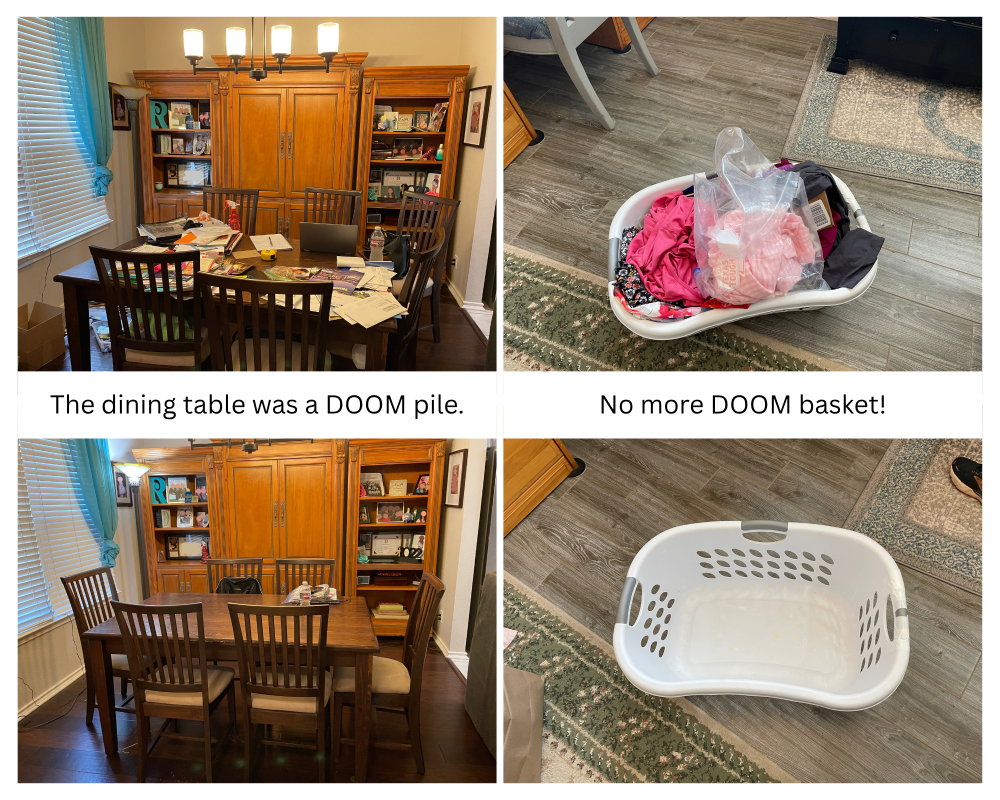
Have you heard of DOOM boxes or DOOM piles? The acronym stands for “Didn’t Organize, Only Moved.” It does a good job at conveying the feeling that these piles of stuff have upon us! Doom piles are typically piles of clutter that are gathered up and stashed out of sight before company arrives, then often remain where they were hidden instead of being dealt with. (This reminds me of Andy Warhol’s time capsules, but without the deliberate curation.) By extension, doom piles also refer to piles of clutter that accumulate over time anywhere in a house, even if they don’t move.
A doom pile often forms so slowly that you don't notice it. It's little bits and bobs of clutter that aren't dealt with in a timely fashion, so they just sit there. Typically, it forms because making a decision about an item takes more mental energy than just dumping it on top of a pile. After a while, a sort of clutter blindness sets in: our brain stops seeing them, which makes us even less motivated to deal with them. But they still drain our energy, and the pile starts to feel insurmountable. If we stash the clutter out of sight when company comes over, we are even less likely to deal with it later on! I have helped many clients deal with such piles, boxes, bins, and bags of random items they had stashed away.
Conversely, some doom piles can form all at once. For example, I helped a client deal with an entire doom closet in which everything had been stashed when they redid the floors in their house - then they simply never got around to taking the things out of the closet again, because it was too overwhelming.

Doom piles represent unmade decisions and unfinished projects, and the more they build up, the more overwhelming they become. It's hard to focus when this pile, which is really a to-do pile, is in the way! It can also negatively affect our confidence because we may think less of ourselves for not being able to deal with it or for not having a tidy, company-ready house.
Studies show that living in a cluttered environment increases our levels of the stress hormone cortisol, and this is especially true for women (more on that here). Even if we don't consciously register clutter, or choose not to deal with it, our mind still perceives it as an irritant, and it will drain our energy.
Dealing with doom piles
It's important to deal with our things! We deserve a nice, peaceful environment to live in. It helps our home function better, it helps us feel better, and it can even save us money by ensuring we don't misplace important items in the doom pile and end up buying duplicates. Keep in mind, too, that cleaning is easier without the piles; otherwise, we can dust or vacuum around items, but we can never actually clean an area properly if it is cluttered.
The best way to tackle a doom pile is to be mentally prepared to deal with the items - set a timer for 15 minutes and see what you can accomplish in that time. You can put on some music if it helps you. Create clear categories as you go so that you know how to deal with items you find. Examples would include "trash/recycle", for things that will obviously be discarded; "relocate", for items you want to keep and that actually belong elsewhere (put them in a basket and then redistribute them when the timer goes off); "donate"; or "act on" (I'm thinking mainly of important papers you might come across, or maybe a broken item you want to repair). However, one category of items may be the most important: "decide". This is for things that came into your life and that you haven't made the conscious decision to keep, yet you haven't discarded them either. This is what I mean by unmade decisions: you need to decide if you actually want to own and care for that item, and if so, where it will live! This is the toughest part because it requires actual decision-making.
If even making these categories as you go is overwhelming, consider the Doom Diamond method, in which you only make four categories (representing the four points of a diamond figure): trash / action / items with a home / items without a home. Throw away the trash, take the action, return items to their home, then… make those decisions about items without a home.
Preventing doom piles when possible
A good way to avoid doom piles is the one-minute rule: if it takes less than one minute to do something, just do it now instead of putting it off. Corollary: when handling an item, don't put it down - put it away. I also recommend doing a reset every evening as well as setting aside some time weekly to deal with items that have come in and started to pile up. Make sure you deal with your mail, permission slips from school, etc., at least weekly.
Notice where things tend to pile up and see if you can set up systems to help you with those specific areas. For example, maybe you could use a tray on which to drop your keys and the mail near the front door, or a shoe rack in the garage. I'm a big fan of having a landing zone near your front door, which is also useful for things that need to go back out of the house (packages to return, library books, etc.). And make the conscious decision to reduce influx at the source: unsubscribe from unwanted mail, refuse freebies that you are not excited about... And always think about where any new item will go before acquiring it.

Hi there! I’m Amélie, a professional home organizer in San Antonio, Texas. I help people like you declutter their home, organize their belongings, and simplify their life. I love cleaning out a closet and removing a carload of donations from a home! My goal is to help you create a functional space that will make your life easier and more peaceful.
Interested? Check out my personalized services or book your complimentary consultation!
The junk drawer
I recently saw this Etsy listing for a junk drawer starter kit, containing batteries, rubber bands, matches, a screwdriver, a flashlight, scissors, tape, and a pen. At first I laughed, but then realized that the things in there were useful and, therefore, this was not necessarily a gag gift. But it also made me want to define exactly what a junk drawer is.

Photo taken by Karolina Grabowska for Pexels.
According to Wiktionary, a “junk drawer” is a “drawer designated for the storage of various miscellaneous, small, occasionally useful items of little value.” The reason I don’t really like the term “junk drawer” is because to me, “junk” makes it sound like useless stuff, whereas in people’s homes, the contents of the junk drawer are actually useful!
The mid-century modern furniture company Joybird conducted a survey of 1,900 people in 2020 and determined the top 10 items that people keep in their junk drawer, which are (in order): tape, pens, spare batteries, scissors, flashlights, glue, paper clips, matches, rubber bands, and keys.

Infographic reprinted with permission from Joybird.
So here’s the thing: even though I consider myself to be someone who does not have a junk drawer, I do have all of these items in my home – they are just not stored together. I have a home office (albeit in an open area), so office supplies like tape, pens, scissors, glue, and paper clips are stored there. I keep the flashlight and spare batteries in the hall closet, the rubber bands in the pantry, and the matches (along with birthday candles) in a high cupboard out of reach of the kids. In the kitchen, I do have a small drawer of miscellaneous useful items such as masking tape and a marker (to label things going into the freezer), kitchen twine, bag clips, and a first aid kit, but to me that’s a utility drawer, not a junk drawer. It’s all in the wording, right?
The important thing is for every item to have a place, so that you know just where to look for them (and put them away). I love using small trays such as these to corral small items in place. Small trays allow you to customize your drawer, and designating a home for your items keeps order in the drawer and helps you find things more quickly. You can also use small boxes, lids, or even mismatched saucers. If you’re like me and like to label all the things, consider clip labels made specifically for drawer organizers! Labels aren’t necessarily for you so much as for the other members of your household to know where to put things back, instead of just tossing them in there and shutting the drawer.
Here’s to making peace with your junk drawer!