
Clutter data
This post is not intended to trend or do wonders for my SEO or your attention span, but I want it here as a record. You see, I have undergrads in biology, psychology, and journalism, so I’ve been trained to cite my sources. Which is why, when I say things like “clutter increases levels of the stress hormone cortisol!” there’s always a part of me that feels like I need to prove what I say instead of having you take my word for it. My intention is to use digestible snippets of this post in my social media and elsewhere, and to simply link back here where I cite my sources for anyone who is interested. And if you’re into data, this post is for you too!
“Clutter is a) too much stuff in too small a space; b) anything you no longer use or love; or c) anything that leads to a feeling of disorganization.”
1 – The effects of clutter on cortisol for women
Let’s start with that study I just mentioned, the one from UCLA in 2010. We know that “people's experiences and perceptions of their everyday environments can inform their well-being.” This study was looking specifically at cortisol. A high level of cortisol has “been associated with greater chronic stress, disease progression, and even mortality risk” and “specifically linked with greater psychological distress including symptoms of depression and post-traumatic stress disorder, poor coping skills, a perceived lack of social support, and compromised relationship functioning.” (Some people report lower satisfaction in their relationships because of misunderstandings, stress, avoidance, and feeling isolated.) Moreover, women living in cluttered homes reported an increase in depressed mood as the day wore on, but for those living in a restorative home, the opposite was true. It was also noted that men’s stress decreases after their workday, but women’s stress tends to stay the same or increase, because they view their obligations at home as stressful. The clutter is a visual reminder of those obligations.
“The results of this study suggest that women's descriptions of their homes may predict their everyday experiences of stress and negative mood. Wives who described their homes as being more stressful (that is, who talked more about clutter and unfinished projects) had marginally lower marital satisfaction. Wives who described their homes as more stressful also had […] an indicator of chronic stress that has been linked with adverse health outcomes. They also tended to show greater increases in depressed mood across the day, consistent with greater fatigue in the evening and a more difficult transition from work to home.” No wonder they say they’re overwhelmed!
“Our largely null results for husbands, contrasted with significant results for wives, suggest that women may be more sensitive to the home environment or may feel a greater sense of responsibility for the home (for example, feeling guilty about clutter); this finding would be consistent with other research suggesting that the home is traditionally perceived as women's domain and ultimate responsibility, even in couples where both partners are employed.” (Women actually do tend to be judged more harshly – see point 2 below.)
We can argue about why that is. Maybe when we view our home as cluttered, it causes us to perceive more stress than when we view it as restorative. Or maybe a restorative home really does help alleviate the effect of the day’s stressors. It could also be that there is an underlying variable that affects both our view of our home and our cortisol levels, such as frustration with gender roles, carrying the mental load, or a lack of self-efficacy (see point 8 below for more on that).
2 – Women are judged more harshly than men for clutter
There was a study in Sociological Methods & Research (actual study here, great breakdown here) that had participants rate how messy a room was, and judge the owner of the room. They saw the same photo, but some were told it was Jennifer’s room, and others were told it was John’s. Interestingly, “men and women respondents do not differ in their perceptions of how messy a room is or how urgent it is to clean it up. In contrast, the gender of the room occupant has strong and significant effects on housework perceptions, moral judgments, perceived social consequences, and allocations of responsibility. Notably, when a relatively clean room is evaluated, female room occupants are held to higher standards of cleanliness, are believed to suffer more negative social consequences when they do not meet those standards, and are generally deemed more responsible for housework across a variety of work–family arrangements than their male counterparts. […] Overall, findings underscore and refine the theory that gendered beliefs and accountability practices are a root cause of gendered behavior in the household.” So men and women perceived the same mess – it’s not that men don’t see the mess, it’s just that they are less to motivated to do anything about it. Also, women correctly perceive that they will be judge more harshly for being messy or having a cluttered home!
3 – Clutter takes up mental bandwidth
According to a Princeton study, “clutter restricts your brain’s ability to focus. It also limits your brain’s ability to process information. Clutter distracts you, saps your energy and keeps you from getting things done.” It also reduces working memory – that’s the one that temporarily holds needed for complex tasks like reasoning, comprehension, and problem-solving, or easier information like remembering a list of three things to do.
One theory as to why clutter takes up mental space is the Zeigarnik Effect: “the power of unfinished business or interrupted or uncompleted activity to hold a privileged place in memory. Unfinished tasks create a cognitive burden, weigh more heavily on the mind, and are more easily recalled than completed tasks.” Clutter being most often made up of items about which you haven’t made decisions yet (whether to keep it, where to store it, etc.), this makes sense. All those objects are competing for your attention!
Environmental/design psychologist Sally Augustin confirms, “The brain pulls from the sensory inputs it’s receiving at any given moment.” So yes, our space has a direct effect on how we feel,
how well we focus and rest, and our overall well-being. That same source also quotes therapist Annie Guest, saying “Well-organized living spaces reduce anxiety and promote calm” as well as creativity.
Reducing the number of decisions helps free up that mental space for things you actually want to do. In other words, reducing clutter gives your brain more energy – because it’s not just about stuff, it’s about the mental load as well.
4 – Clutter has a cumulative effect
We just talked about how clutter creates distractions – you see an object, and you think about where it came from, how it represents a task you have to do, it reminds you of something else, etc. When many objects are in your field of vision, they compete for your attention, which reduces your ability to get anything done.
This study went deeper. “What’s worse is that clutter has a cumulative effect on our brains - that is, the more you are exposed to clutter, the more distractible you become. Since your brain is naturally predisposed to favor order over chaos, constant visual disorganization tires the brain, impairs working memory, and makes it harder and harder to regain focus.” And remember how clutter increases cortisol? That creates stress and anxiety, and those impede learning as well.
Luckily, it turns out that decluttering really does help cure the problem, by boosting memory and focus. A study by the Royal Australian College of General Practitioners showed that “the visual distraction of clutter increases cognitive overload and can reduce our working memory. In 2011, neuroscience researchers using fMRI (functional magnetic resonance imaging) and other physiological measurements found clearing clutter from the home and work environment resulted in a better ability to focus and process information, as well as increased productivity.” There is also less mental fatigue with less clutter. So keep in mind that the benefits of a tidy work environment aren’t just subjective! It helps support your brain, your health, and your mood.
5 – Clutter negatively affects your health as well
Still quoting that study by the Royal Australian College of General Practitioners, “a chronically cluttered home environment can lead to a constant low-grade fight or flight response, taxing our resources designed for survival. This response can trigger physical and psychological changes that affect how we fight bugs and digest food, as well as leaving us at greater risk of type 2 diabetes and heart disease. (…) And surprisingly, it doesn’t go away when we finally get to bed. People who sleep in cluttered rooms are more likely to have sleep problems, including difficulty falling asleep and being disturbed during the night.”
We’ve also long known that there is a link between clutter and weight. “Multiple studies have found a link between clutter and poor eating choices. Disorganized and messy environments led participants in one study to eat more snacks, eating twice as many cookies than participants in an organized kitchen environment. Other research has shown that being in a messy room will make you twice as likely to eat a chocolate bar than an apple. Finally, people with extremely cluttered homes are 77% more likely to be overweight. Tidy homes have been found to be a predictor of physical health. Participants whose houses were cleaner were more active and had better physical health, according to another study.”
“Research does indeed show cluttered home environments negatively influence the perception of our homes, and ultimately our satisfaction of life.”
6 – Kids play more with fewer toys
A study in the Journal of Infant Behavior and Development showed that kids play twice as long, and in more creative ways, if they have fewer toys. “Playing in an environment with fewer toys and noise helps eliminate disruptions and may positively affect the neurodevelopment of attention skills, which are important to cognition as well as problem-solving, sequencing and communication skills. (…) Young children who play in environments with fewer toys tend to display sustained levels of attention, increased imagination, perception and cognition, and motor coordination.”
7 – Clutter makes your life go faster
Sounds crazy, right? It’s from a study in Nature Human Behaviour.
“We observe that scene size and memorability dilate time, whereas clutter contracts it.”
The researchers observed that when participants looked at a cluttered scene, they underestimated how much time had elapsed. This could mean that living in a cluttered home makes time seemingly go by faster, and feeling like your life is slipping away from you would also track with the perceived lack of autonomy exposed in point 8 below. Conversely, memorable scenes go by more slowly – we can live in the moment when we have quality time doing what we love, with the people we love.
8 – How many people are disorganized?
In the 2022 State of Organizing Report, a white paper published by MaxSold, a survey found that 43% of respondents feel disorganized, and for 69%, staying organized is a key challenge.
About 83% of respondents said that some areas of their home occasionally get disorganized, especially the kitchen and storage spaces, but most people do declutter them periodically. People who see themselves as organized were more likely to declutter promptly. Meanwhile, “disorganized people report worrying more that clutter means they are losing control, avoid decluttering for as long as possible, and only do what is necessary to get on with other tasks, when compared with organized people.”
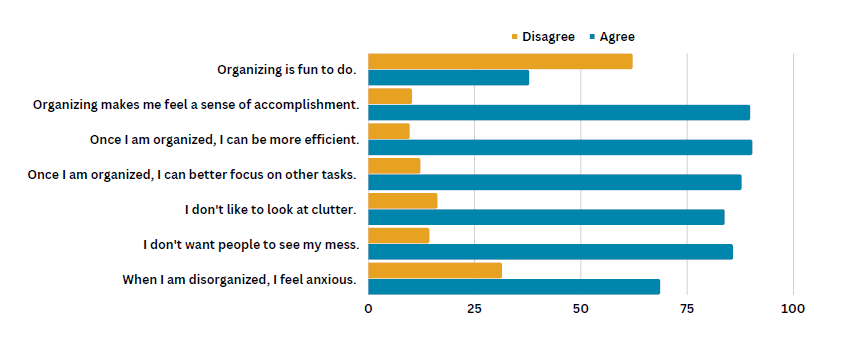
From the 2022 MaxSold State of Organizing Report
From a behavioral psychology point of view, here are four fields of study related to professional organizing: a sense of home and psychological home; attachment to possessions; indecision and procrastination; and finally, well-being and positive psychology (how and why individuals flourish). Some people will be more affected by one aspect than others, but all of these show up in my sessions. It could be someone who feels at home because they are surrounded by objects they love; a mom who can’t let go of her older child’s baby clothes; a retiree who just doesn’t know where to start to tackle the clutter; or a young professional who values organizing because of how good it makes them feel to have a tidy home.
I presented place attachment as a positive thing, but it can become dysfunctional in a situation where someone has become too attached to a home that has become unsafe, or in a case of forced relocation. As for possession attachment, while it is perfectly normal to see items as extensions of ourselves, it can go too far. Clutter has negative impacts on people’s lives, creating tension between family members, social isolation, depression, and safety hazards. It also has a strong negative impact on feelings of security and comfort in our home. Let’s look at the next point to learn more.
9 - The dark side of home: Assessing possession “clutter” on subjective well-being
In this study, the authors showed that clutter can “undermine the comfortable everyday experience of ‘at home-ness’ people take for granted until clutter and disorganization erode their ability to find things, move safely throughout their home, and use spaces as intended.” So having too much stuff can get in the way of everyday activities, like cooking, cleaning, or even moving safely through the home. Clutter absolutely has a negative impact on our enjoyment of home and our subjective well-being. It can “create disconnectedness from important dimensions of at-homeness.”
The thing is that our possessions are a big component of our identity. “Possessions are used to distinguish self from environment, distinguish self from others, manage changes to identities, and as one ages, promote a sense of continuity across the life span. […] Attachments to material objects solidify not only the interconnection between self and objects, but also between self and home.” Our possessions help us create, express and remember who we are; they make our house a home. As we get older, then, our attachment to our possessions might deepen, which would make leaving home even more distressing. We know that “allowing older people to take cherished objects with them to new residential settings contributed to their sense of connection to cherished memories and relieved stress associated with having to part from familiar home spaces.”
But “these normal possession meanings, if taken to extreme, can become maladaptive, especially when clutter accumulates to a point in which it threatens to interfere with daily life functions within home environments.” Among participants to the study, a common theme was feeling “engulfed” and “overwhelmed” by the clutter around them; they felt “trapped.” The researchers found that “clutter is often an insidious and seemingly harmless outgrowth of people's natural desire to appropriate their personal spaces with possessions that reflect self-identity and remind them of important people, places, and experiences in their lives. However, when clutter becomes excessive, it can threaten to physically and psychologically entrap a person in dysfunctional home environments which contribute to personal distress and feelings of displacement and alienation. [The] findings revealed negative impacts of clutter on a person's life (e.g., tension between family members, social isolation, depression, and safety hazards) can detract from the normally positive benefits of psychological home and exert a direct negative impact on subjective well-being.”
Another interesting point to me is that there are “five positive dimensions of at-homeness that can become replaced by negative dimensions when home environments are compromised. These dimensions are: 1) rootedness, or the ability to conduct normal routines, replaced with disconnectedness, including bodily discomfort, loss of mobility and accessibility; 2) appropriation, or feelings of autonomy and control, replaced with imposition, loss of autonomy, or dependence on external assistance; 3) at-easeness replaced with uneaseness, when residents' life worlds are called into question by personal, social, or environmental elements; 4) regeneration, or the restorative powers of home, replaced with degeneration, or disruptions caused by personal, social, or environmental changes; and 5) warmth replaced with coldness, when the ‘spirit’ of home devolves into raw material space.” I think this is important because it lets us know which aspects of at-homeness are most important, and why, which makes it easier to create a home that is more welcoming to us.
10 – Procrastination and clutter
Another study showed that tendencies such as delaying and avoiding unpleasant tasks (like decluttering) can culminate in one’s lifetime, and clutter leads to reduced quality of life, satisfaction with life, and negative self-image. While everyday forms of procrastination lead to everyday forms of clutter, as one ages, chronic procrastination and clutter can lead to not-so-average kinds of distress and identity, impacting well-being. This means that older adults are particularly negatively affected by their clutter! Chronic procrastination is also correlated with personality variables like low self-confidence and self-esteem; increased depression, neurosis, self-consciousness, and anxiety; and forgetfulness as well as maladaptive disorganization. This is not to say that procrastination is causing this, but that it, and clutter, are correlated with these negative outcomes. Procrastination is essentially making yourself feel better in the moment (by delaying when you tackle the difficult thing), but it does not help you in the long term.
11 – Materialism and well-being
A new study published in 2020 examined this link. Studies have consistently shown a link between materialism and lower levels of personal well-being (including life satisfaction, family relationships, and leisure). That is because you cannot meet the psychological needs of autonomy, competence, relatedness, mental space, and awareness by buying more stuff! People who adopted a minimalistic lifestyle reported a feeling of freedom and liberation: “not only from their possessions, but from societal expectations; from the monotony of routine; and from the trap of the hedonic treadmill” (the endless cycle of buying something and expecting it to make you feel better). They also reported saving time, mostly from not having to clean or organize so much.
All this allowed minimalistic participants in that study to align their actions with their values and authentic selves: spending more quality time with their family and friends, spending money on experiences rather than possessions, being more ecofriendly, not being tied to a boring routine, etc. When they did buy something, it was a thought-out purchase that added joy or value to their life.
Minimalism provided a sense of control and ownership of their environment, as well as the ability to maintain control. “Almost all participants conveyed the belief that what is happening in one’s physical space (the external world) is reflected in one’s mental space (the internal world) and vice versa.” It also provided competence, for example by allowing people to easily find what they were looking for, or fixing broken items instead of buying new ones.
“Many participants identified the idea of saving ‘mental energy’ as a benefit of minimalism that promotes well-being. Participants reported this was due to having fewer choices to make and not preoccupying the mind with trivial matters. It’s almost like saving your brain energy by reducing the things that you have to actually think about.” The researchers noted that cluttered homes and classrooms could therefore be detrimental to attention, cognition, and learning.
Participants reported a heightened awareness, and enhanced reflection, mindfulness, and savoring as a result of minimalism. One said, “I would much rather buy something that’s really nice and well-made that I can appreciate and savor and just have one of those rather than have lots of things that are kind of a bit cheap that I don’t really engage with.”
“In addition to the absence of stress and anxiety, all participants reported that their minimalistic lifestyle was a catalyst for positive emotions, in particular joy and peacefulness. Positive emotions appeared to stem from the other benefits of minimalism: autonomy, competence, mental space, and awareness.” One said, “I’m just not the same person I used to be… I’m very peaceful and calm and very happy.” Another said, “A lot calmer. Definitely a lot calmer.”
It could be that clutter had a direct effect on participants’ well-being, or it could be that feeling more autonomous, aware, or competent as they cleared the clutter made them happier. Either way, the benefits of decluttering are undeniable!
12 – Letting your brain work for you
I’m updating this post on 12 October 2026 with quotes from Dr. Emily Falk, a neuropsychologist quoted in the New York Times. Understanding how our brain works and how it makes decisions can help us change our mindset about things and achieve our goals. “It isn’t irrational to have trouble letting objects go. The parts of our brain that help us decide what is valuable overlap with the parts that keep track of what feels like us. As a result, we feel that what is ours is good, and we increase the value we attach to objects, ideas and behaviors from our past.” Objects can also act as cues that reconnect us to the version of ourselves from a specific time in our life. This explains why we are so attached to family heirlooms and things that remind us of our past (whether it be childhood, college, or another era).
In order to let go more easily, taking a picture of a beloved item often helps. Another trick is to shift our perspective from owner to buyer. For example, instead of asking ourselves whether we want to continue owning, or discard, a specific item, we can instead ask ourselves whether we would buy this again today. “Modifying the decision-making framework allows a neural calculation in reward and self-relevance systems to shift, too. A teakettle becomes something you can choose — or not — rather than something you stand to lose.” You can also try to shift your perspective and see things from someone else’s point of view. Sure, you want to keep your mug collection, but it is overflowing and it gets in your partner’s way. Can you see things from your partner’s point of view and see the excess mugs as clutter? Can that help you cull you collection to a reasonable number of favorite mugs?
“Modifying the decision-making framework allows a neural calculation in reward and self-relevance systems to shift, too. A teakettle becomes something you can choose — or not — rather than something you stand to lose. […] Letting go isn’t hard because the objects themselves are objectively so precious. It’s hard because the brain sees it as changing who we are — and resists that. The same is true for our old ideas and behaviors. But if we take a step back and use our imagination and connection to others to see the problem in a new way, we can more purposefully let go of the things that aren’t serving us without losing the core of who we are.”

Hi there! I’m Amélie, a professional home organizer in San Antonio, Texas. I help people like you declutter their home, organize their belongings, and simplify their life. I love cleaning out a closet and removing a carload of donations from a home! My goal is to help you create a functional space that will make your life easier and more peaceful.
Interested? Check out my personalized services or book your complimentary consultation!