
5 tips for organizing a closet
Your closet is often the first thing you look at in the morning, and it sets the tone for your day. Ideally, it should feel like a party where you know everyone and, more importantly, actually like everyone! Having an organized, functional closet not only helps you set yourself up for success, it also allows you to start off your day on the right foot because it will help you feel at peace and in control. Apparently, the New York Times said that 31% of people were more satisfied after clearing out their closet than after sex. Regardless of where you fall, read on for 5 simple organizing tips! (See here for product recommendations. As for decluttering tips, you get my list of 10 things to declutter from your closet when you sign up for my newsletter.)
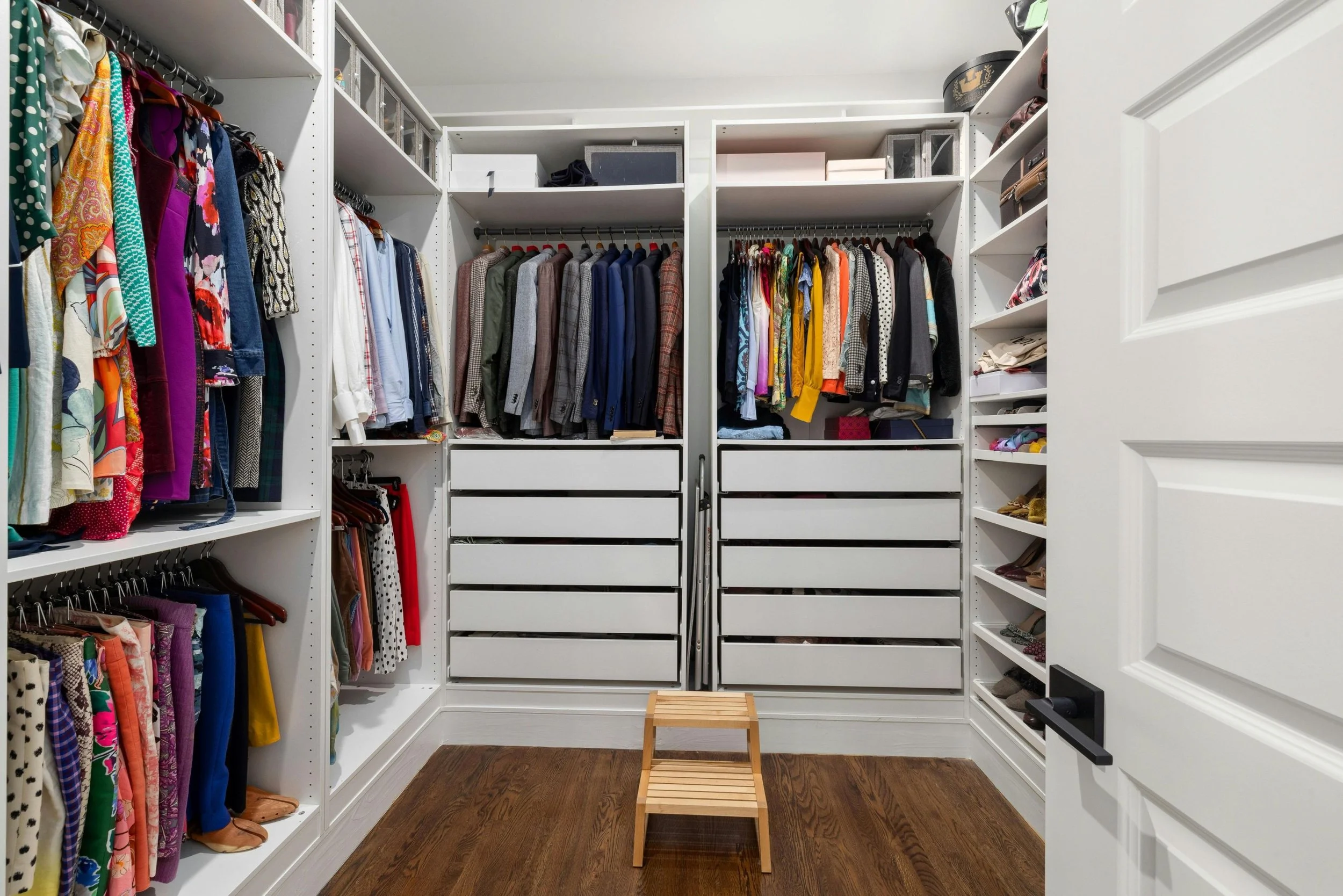
This photo was taken by Curtis Adams for Pexels.
1 – The easiest way to make your closet look better is…
There are small details that will help your closet look and feel more organized, but here’s the most effective one: use matching hangers. And absolutely get rid of the flimsy ones! Replacing your hangers is a simple step to take, but it will make such a big difference! Velvet hangers are inexpensive, yet look stylish, and are functional in that they help prevent your clothes from slipping off. Slim wooden hangers are also a great option, as are very sturdy plastic ones. You won't realize how good it feels to have all those hangers looking uniform until you try it!
2 – The floor is not for storage.
Another common issue is using the floor for storage. Ideally, you shouldn't have anything on the floor of your closet – I don't mean simply that it shouldn't be messy or cluttered, I mean that it should not be the designated home for items such as shoes, sandals, and boots. Try storing those on a shoe rack or on shelves, which will not only make them more visible and accessible, but will also help ensure that you are not tripping over your shoes when you reach for something else. The same is true of handbags and purses – try storing them on the top shelf in clear bags or acrylic boxes, so that they remain visible but do not get dusty. Alternatively, there are purse hangers that will keep them handy without bending the handles and straps.
3 – For the small things.
It is also worth looking at small accessories such as jewelry, belts, scarves, hair ties, etc. If you do not have the luxury of drawers with divider inserts, try a jewelry box (in a closet, I especially like the tall, shallow ones behind a full-length mirror that swings open) or specialty hangers for your belts and scarves. Again, the important thing is to keep your belongings both easily visible and easily accessible. You should also get rid of extra packaging, which I often come across in clients' closets (even if it's from a fancy store and looks nice, it will prevent you from seeing what it contains, and you will lose track of those items - or you will realize that the packaging was empty and just taking up space for nothing).
4 – Plan for the way you use your closet.
Next, see if specific items tend to pile up and see how you can remedy that. I suggest having a hamper in your closet for dirty clothes, as well as a donation box for those items you no longer want (when the box is full, simply donate the contents). I also pack all my travel items inside my largest suitcase, which keeps them contained until the next trip. Keep spare hangers directly on the hanging rod instead of making a pile elsewhere.
Consider installing a few hooks in your closet, too. Spare hooks can be great for those clothes that you wore once and therefore cannot be hung back in your closet, but that are not quite dirty enough to wash yet. You can also use a hook to set up your outfit for the day or for an upcoming special event.
5 – Use bins for folded items.
Most of the time, I recommend getting rid of hanging fabric shelves and stacking plastic drawers – they tend to be flimsy and really not as practical as one would think. Also, try not to stack folded clothes in piles – it’s impossible to reach the items on the bottom, and the piles will eventually topple over anyway. Instead, assuming vertical file-folding in a drawer is not an option, get some open bins and use those the same way you would a drawer. This helps keep items such as t-shirts visible and accessible. Bins are also great for swimsuits and coverups, or winter accessories like hats and gloves.
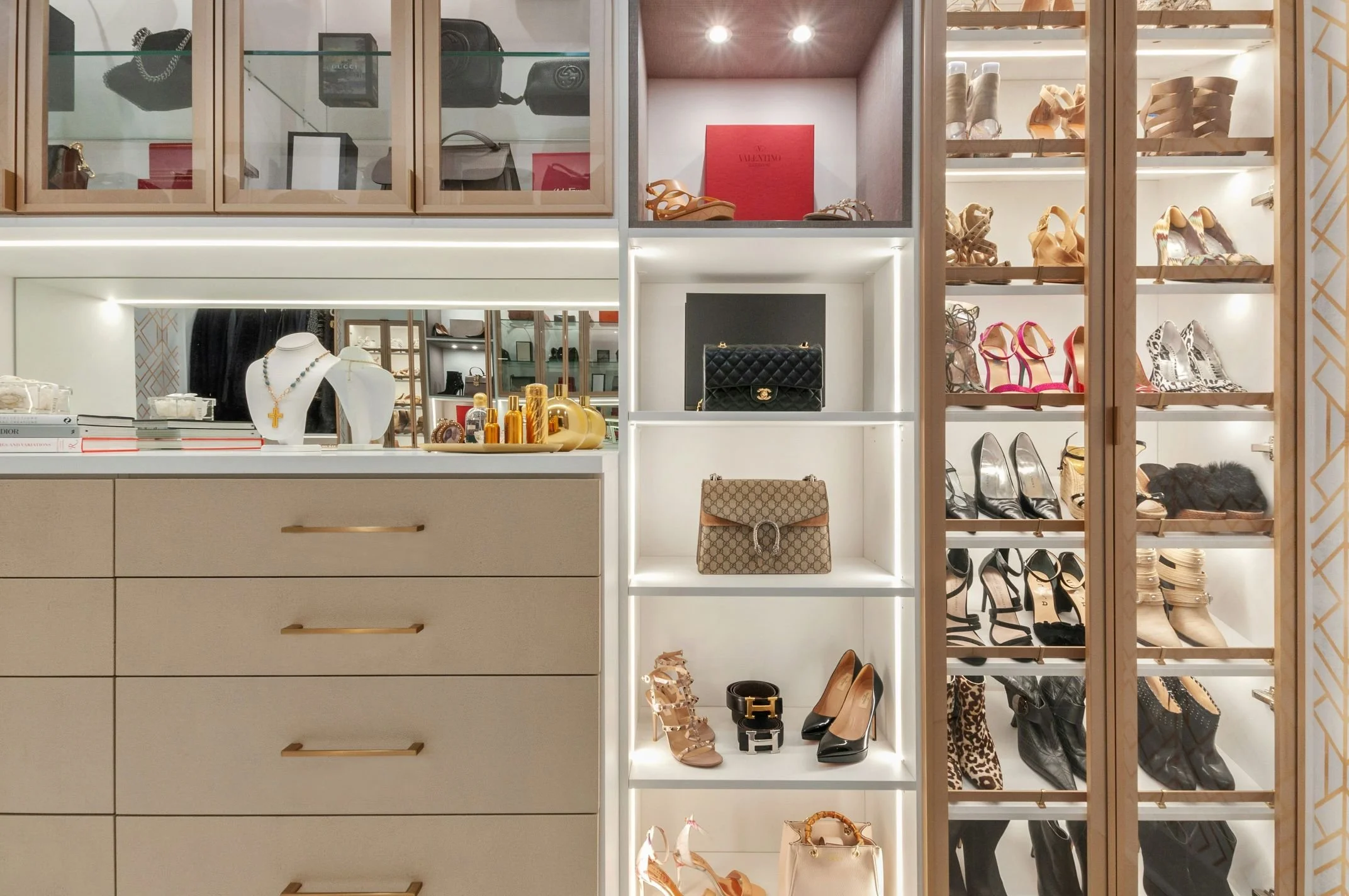
This photo was taken by Chastity Cortijo for Unsplash.

Hi there! I’m Amélie, a professional home organizer in San Antonio, Texas. I help people like you declutter their home, organize their belongings, and simplify their life. I love cleaning out a closet and removing a carload of donations from a home! My goal is to help you create a functional space that will make your life easier and more peaceful.
Interested? Check out my personalized services or book your complimentary consultation!
Clear Your Clutter with Feng Shui
Feng shui is an Ancient Chinese practice of arranging environments to balance qi (life force) as well as promote health, harmony, and prosperity. Now, I’ve always been on the fence about feng shui – some aspects of it seems like woo to me, yet other aspects just seem like common sense. For example, I don’t believe in good or evil spirits that would, respectively, enter or flee a home if they see a mirror near the front door. That being said, I do think it’s very useful to have a mirror by the front door, were it only so that you can take a quick look at yourself before you set out for the day (and fix your appearance as needed!). Mirrors are also useful to reflect light, and they can be aesthetically pleasing focal points.
All this to say, I read a very interesting book recommended by a colleague of mine: Clear Your Clutter with Feng Shui, by Karen Kingston (that is an affiliate link). This book seemed particularly interesting to me because it explores the relationship between clutter and feng shui / life force. Clutter certainly does stop the flow of energy in a room – and maybe you would phrase it differently, by saying that it’s your eyes that can’t travel around the room freely, or that you feel stuck or weighed down in that room, or it makes you feel anxious and you can’t breathe properly, but I think that it adds up to the same.
Here is an excerpt: “You are energetically connected to everything you own. When your home is filled with things that you love or use well, it becomes an incredible source of support and nourishment for you. Clutter, on the other hand, drags your energy down and the longer you keep it, the more it will affect you.” The author also talks about the fact that clutter takes up a lot of mental energy, even as your subconscious mind tries to suppress it, and so you feel more energetic with less clutter – that is definitely something I have seen with clients, and I talk about it often on social media!
Karen Kingston goes on to define four categories of clutter: things you do not use or love, things that are untidy or disorganized, too many things in too small a space, and anything unfinished. It’s an interesting way to categorize it! The first category clearly overlaps with core tenets of the KonMari Method™. I certainly agree that things that are messy come across as clutter (even if they can be put away easily), and I’m a big believer in the container concept – meaning that the size of your space tends to dictate how many things you can comfortably keep. As for unfinished projects, they are one category that I always name as a source of clutter! I think I would add categories such as things that bring back bad memories, things that are tied to decisions you have been putting off, etc.
(On a side note, I strongly believe in the importance of choosing objects that you love. For example, you might have a kettle that you use frequently, but you don’t really like it – maybe it’s ugly, or water doesn’t pour out of it properly, whatever the reason. I encourage you to invest a bit more and buy a kettle that you love! Loving your everyday objects truly elevates your experience and makes you happier overall.)

This image was created by Klub Boks for Pexels.
In this book, the author also talked about bagua, or the concept of specific areas of a room or home being associated with aspects of your life such as health, prosperity, or relationships. The more cluttered a specific physical area is, the worse you will be doing in that figurative area in your life. According to this theory, the rear left corner of a room would be associated with knowledge. My instinct is to say that’s woo. And yet, I now realize that in my home office, that is precisely where I keep my bookcase of reference materials and dictionaries! I feel like this is something I’d like to experiment with, maybe by making the “travel” area of my home super inviting!
Have any of you thought about the relationship between feng shui and clutter?
Hi there! I’m Amélie, a professional home organizer in San Antonio, Texas. I help people like you declutter their home, organize their belongings, and simplify their life. I love cleaning out a closet and removing a carload of donations from a home! My goal is to help you create a functional space that will make your life easier and more peaceful.
Interested? Check out my personalized services or book your complimentary consultation!
MYTH - “Your house must be perfect”
When people find out that I am a professional organizer, I typically get one of two responses. It’s either “I really need you in my life” (yes, please – click here for your complimentary consultation!) or “Oh, I bet your house is perfect!” And, about that latter statement… no, it’s not. But as I keep saying, there is a difference between having a tidy house (as in, picture-perfect at all times) and having a house that is *easy to tidy*. I aim for the latter because that’s what I feel is realistic.
Here's what I mean by that. Once you declutter and organize, all your things will have a home. Of course, your house still will get messy at times because, well, you live there, and you use your stuff! But if those items have a designated home, then when you want to put things away, you can do so quickly, so your house can look neat again without too much effort. But if your house is cluttered, those items don’t have anywhere to go, and that’s really the issue that I try to address with my clients.
Resets are important
Everyone needs to “reset” their home, myself included. It might be a nightly reset, like making sure the dishes have been washed and the kitchen counters are wiped clean each night. It could be weekly, like picking up toys and vacuuming, or doing the laundry that has piled up. It could be quarterly, like assessing your wardrobe when the weather changes every season or setting up the garage based on your needs for the next few months.
Sometimes, we need to do more than a reset – it might need to be a complete overhaul, because our life changes. Looking at my pantry, for example, I remember a time when it was used only to feed two adults; then we had to store jars of baby food and boxes of Mum-Mum crackers and rice puffs; now, it has school-safe snacks and other sundries that the kids access themselves. It works because we zone everything, and rezone as needed.
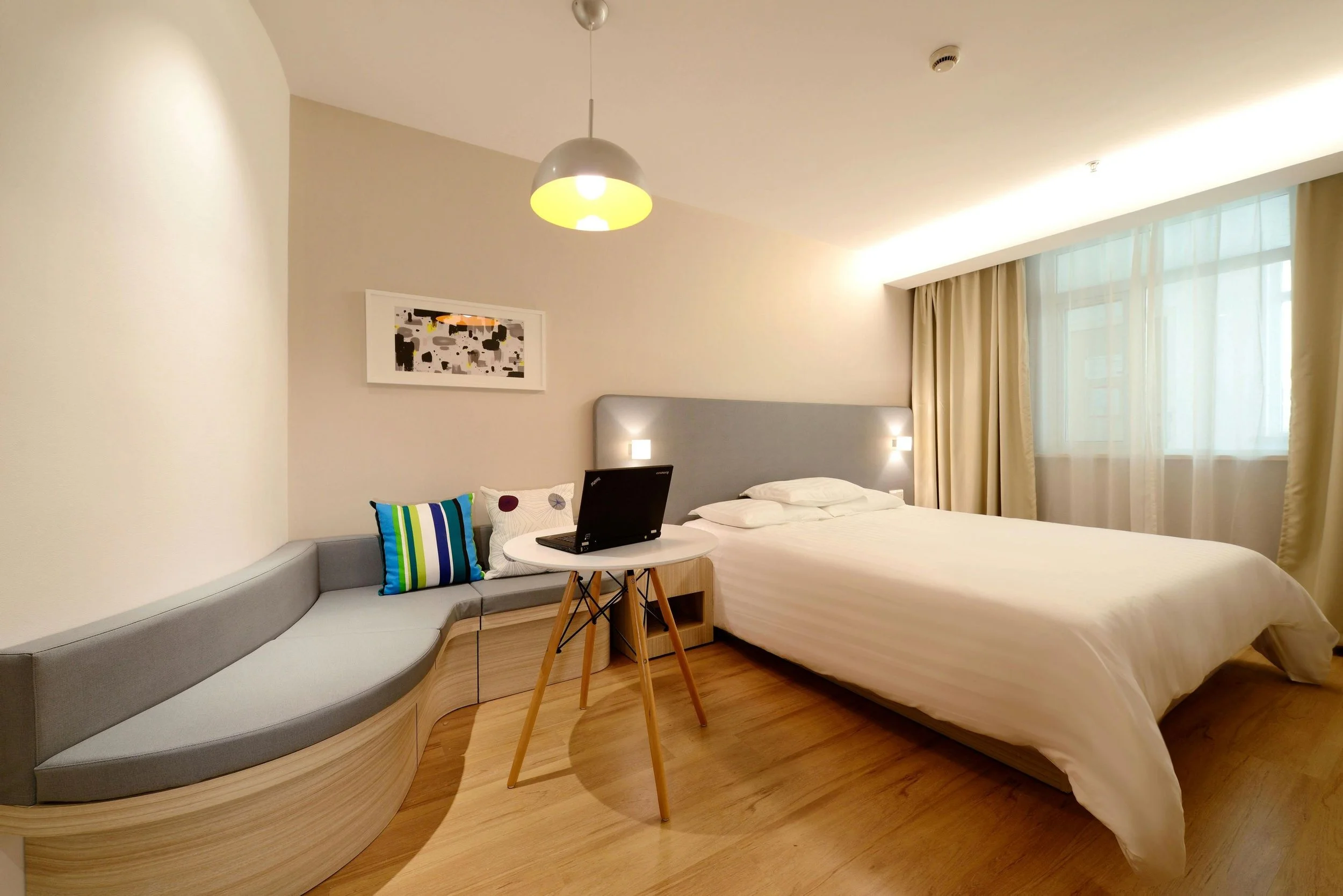
This is not my guest bedroom, but I like this photo because it does show proper zoning, with a defined zone for sleeping and one for sitting and working on the laptop. Photo by Pixabay for Pexels.
Zoning a room
Let’s bring this together with a real-life example from my own home: the spare room. When my husband and I first moved into the house, this room was strictly a guest bedroom, with a double bed and two nightstands. Eventually, we had kids, and the room that I had been using as a craft room (sewing supplies, wrapping paper, etc.) had to become a child’s bedroom, so we relocated the craft supplies to the guest bedroom. This meant trading the bed for a Murphy bed, which takes up very little room when not in use, and setting up the sewing machine on a sturdy folding table, which can be put away in the garage when we have guests. Eventually, during the pandemic, it doubled (tripled?) as a home classroom, with the sewing machine set aside on the floor and a laptop on the table instead. Fast-forward to today, and it’s also the music room, currently holding a marimba as well as a drum set, plus an electric guitar. Oh, and did I mention it’s where I do my ironing?
As you can imagine, this room has A LOT of stuff in it! But it works for us because we use all those things, albeit at different times. And yes, we do have to move them out of the way temporarily when we have guests, so our “guest bedroom” is certainly not Pinterest-worthy! But it is organized because we’ve set up the items there in zones and we kept only what we used. And, let’s be honest, because we have a contingency plan for where to temporarily store those items when the room is used as a guest bedroom! It is perfectly functional for our lives at the moment, though it’s not “perfect” at all.
Hi there! I’m Amélie, a professional home organizer in San Antonio, Texas. I help people like you declutter their home, organize their belongings, and simplify their life. I love cleaning out a closet and removing a carload of donations from a home! My goal is to help you create a functional space that will make your life easier and more peaceful.
Interested? Check out my personalized services or book your complimentary consultation!