
DOOM piles
Have you heard of DOOM boxes or DOOM piles? The acronym stands for “Didn’t Organize, Only Moved.” It does a good job at conveying the feeling that these piles of stuff have upon us! Doom piles are typically piles of clutter that are gathered up and stashed out of sight before company arrives, then often remain where they were hidden instead of being dealt with. (This reminds me of Andy Warhol’s time capsules, but without the deliberate curation.) By extension, doom piles also refer to piles of clutter that accumulate over time anywhere in a house, even if they don’t move.
A doom pile often forms so slowly that you don't notice it. It's little bits and bobs of clutter that aren't dealt with in a timely fashion, so they just sit there. Typically, it forms because making a decision about an item takes more mental energy than just dumping it on top of a pile. After a while, a sort of clutter blindness sets in: our brain stops seeing them, which makes us even less motivated to deal with them. But they still drain our energy, and the pile starts to feel insurmountable. If we stash the clutter out of sight when company comes over, we are even less likely to deal with it later on! I have helped many clients deal with such piles, boxes, bins, and bags of random items they had stashed away.
Conversely, some doom piles can form all at once. For example, I helped a client deal with an entire doom closet in which everything had been stashed when they redid the floors in their house - then they simply never got around to taking the things out of the closet again, because it was too overwhelming.

Doom piles represent unmade decisions and unfinished projects, and the more they build up, the more overwhelming they become. It's hard to focus when this pile, which is really a to-do pile, is in the way! It can also negatively affect our confidence because we may think less of ourselves for not being able to deal with it or for not having a tidy, company-ready house.
Studies show that living in a cluttered environment increases our levels of the stress hormone cortisol, and this is especially true for women (more on that here). Even if we don't consciously register clutter, or choose not to deal with it, our mind still perceives it as an irritant, and it will drain our energy.
Dealing with doom piles
It's important to deal with our things! We deserve a nice, peaceful environment to live in. It helps our home function better, it helps us feel better, and it can even save us money by ensuring we don't misplace important items in the doom pile and end up buying duplicates. Keep in mind, too, that cleaning is easier without the piles; otherwise, we can dust or vacuum around items, but we can never actually clean an area properly if it is cluttered.
The best way to tackle a doom pile is to be mentally prepared to deal with the items - set a timer for 15 minutes and see what you can accomplish in that time. You can put on some music if it helps you. Create clear categories as you go so that you know how to deal with items you find. Examples would include "trash/recycle", for things that will obviously be discarded; "relocate", for items you want to keep and that actually belong elsewhere (put them in a basket and then redistribute them when the timer goes off); "donate"; or "act on" (I'm thinking mainly of important papers you might come across, or maybe a broken item you want to repair). However, one category of items may be the most important: "decide". This is for things that came into your life and that you haven't made the conscious decision to keep, yet you haven't discarded them either. This is what I mean by unmade decisions: you need to decide if you actually want to own and care for that item, and if so, where it will live! This is the toughest part because it requires actual decision-making.
If even making these categories as you go is overwhelming, consider the Doom Diamond method, in which you only make four categories (representing the four points of a diamond figure): trash / action / items with a home / items without a home. Throw away the trash, take the action, return items to their home, then… make those decisions about items without a home.
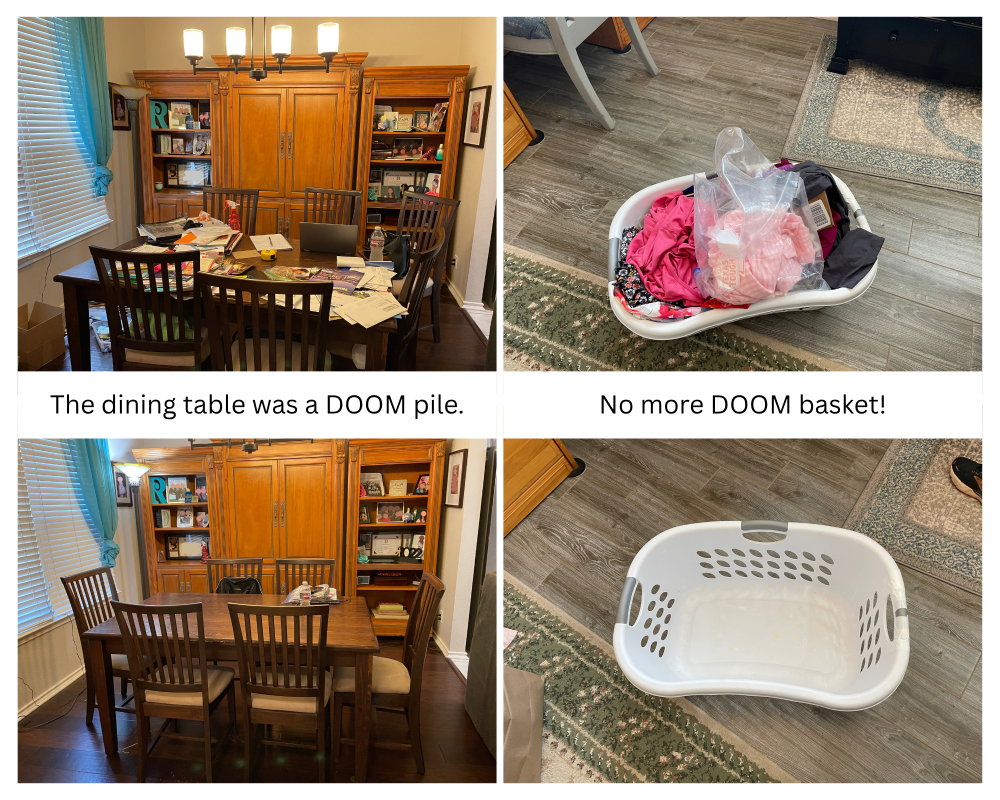
Preventing doom piles when possible
A good way to avoid doom piles is the one-minute rule: if it takes less than one minute to do something, just do it now instead of putting it off. Corollary: when handling an item, don't put it down - put it away. I also recommend doing a reset every evening as well as setting aside some time weekly to deal with items that have come in and started to pile up. Make sure you deal with your mail, permission slips from school, etc., at least weekly.
Notice where things tend to pile up and see if you can set up systems to help you with those specific areas. For example, maybe you could use a tray on which to drop your keys and the mail near the front door, or a shoe rack in the garage. I'm a big fan of having a landing zone near your front door, which is also useful for things that need to go back out of the house (packages to return, library books, etc.). And make the conscious decision to reduce influx at the source: unsubscribe from unwanted mail, refuse freebies that you are not excited about... And always think about where any new item will go before acquiring it.

Hi there! I’m Amélie, a professional home organizer in San Antonio, Texas. I help people like you declutter their home, organize their belongings, and simplify their life. I love cleaning out a closet and removing a carload of donations from a home! My goal is to help you create a functional space that will make your life easier and more peaceful.
Interested? Check out my personalized services or book your complimentary consultation!
Storing socks
This isn’t a real blog post. It’s an inevitable follow-up to my post about simplifying. I want to address a question I get from friends and clients alike, about how to store socks. Can you fold them in such a way that they will stay together? Is it okay to roll them one onto the other or to tie them together? As is the case with many such organizing questions, my answer is: It depends.
The first thing to take into consideration is how you wash and dry your socks. Personally, I do not use the dryer on my clothes (linens, yes, but clothes, no). So once I have clean but damp socks, I smooth them out and hang them on a clothing rack to dry. This means that they dry in a nice, smooth shape, and are then very “docile” about being folded and staying that way.
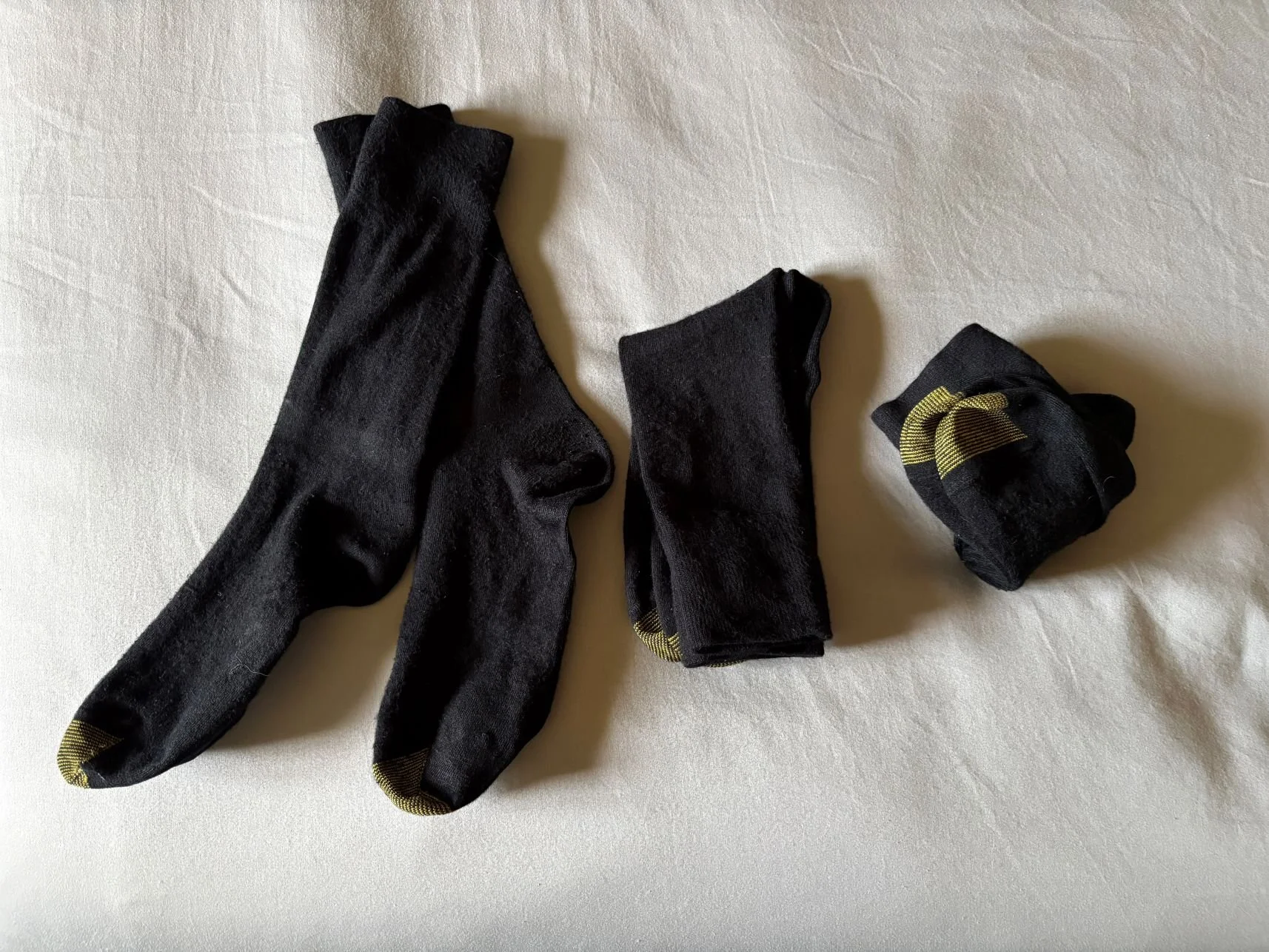
Am I saying that this is how you must wash socks? NO! Many people do not have the time or inclination to hang their clothes to dry and they much prefer using a dryer. That’s fine, but it does mean that your socks will dry with a more crooked or unpredictable shape, so they will be much harder to fold and may not stay neatly folded no matter how hard you try – you’re not doing anything wrong, you just can’t achieve the same results with socks that have been in the dryer. This is the case with many of the homes in which I work, and in those cases, I will “potato” the socks, meaning fold the top of one over the other to keep the pair together in the drawer. (I do not recommend tying them together at all.)
To be clear, the downside of this method is that it causes more strain on the elastic, making the socks break down more quickly. Plus, fabric will take the shape it had when it was drying, so with this method, it is possible that the socks will be less comfortable. Folding is the ideal way to store socks, but I do understand that it is not possible for everyone.
Bottom line: If the way you are currently washing and storing socks works for you, keep doing it. If there is something you would like to improve, let’s figure out how to tweak your system so that it works for you.
Bonus tips: If pairing socks is a pain point for you, try doing it mindlessly as you are watching television. Or have your kids do it! Another tip is to just get sets of matching socks and use a different one for each member of the household. Now the only question will be how to spend the extra time you’ll have!
Bonus bonus tip: Washing smaller loads and not using the dryer seem to be the keys to not ending up with orphaned socks.
Hi there! I’m Amélie, a professional home organizer in San Antonio, Texas. I help people like you declutter their home, organize their belongings, and simplify their life. I love cleaning out a closet and removing a carload of donations from a home! My goal is to help you create a functional space that will make your life easier and more peaceful.
Interested? Check out my personalized services or book your complimentary consultation!
How to get unstuck
It’s very common to get so overwhelmed by a messy, cluttered space that we get stuck! We get analysis paralysis and freeze because we don’t know what the next step is, and the whole task seems like too much. I know it happens to my clients a lot, and it sometimes happens to me, too! People who find themselves in that situation will often just give up – they will ignore the space, which means that it will stay the same or even get worse, but it still occupies a lot of mental bandwidth for them. So, what can we do to get unstuck?
If you feel so overwhelmed by a task that you are unable to start it, it’s because the first step isn’t small enough. So break the task down into smaller chunks to get a better handle on it!

Here is one simple tip I swear by: Pick a corner and start working from there. Maybe I start by picking things up off the floor so that I have room to walk around without tripping. Then I’ll pick a corner of the room and work my way clockwise until it’s done. If there are piles of boxes, I just do one box at a time.
You can also do this in small chunks of time! Obviously, when I go to a client’s home, I might be working for hours at a time. But you can set a timer and do this for 15 minutes, a little bit every day, and you will definitely see progress! The important thing is to keep the momentum going.
Another important point is that you need to define the task. Figure out what actions you need to take, or what your options might be for each item, before you even start.

Let’s say we are working through a pile pf papers. Your options might look like “shred,” “recycle,” “file with taxes,” “file with other important papers,” “keep only until a certain date,” or “act on it.” While you can’t necessarily account for everything, you’ll at least know roughly what to expect and can set yourself up accordingly with a paper bag to hold paper to be shredded, a recycling bin, and a filing system.
If the task is to unpack after a move or to sort through boxes of items that belonged to a deceased loved one, then you know you will need to open boxes and make decisions about the items inside. Keep or discard? And if you are keeping the item, where will you store it? Take it one box at a time.
Finally, get support when you need it.
This could look like having a friend or relative help you, or you can consider hiring a professional like myself or one of my colleagues. Home organizers love to help you solve those problems!
Hi there! I’m Amélie, a professional home organizer in San Antonio, Texas. I help people like you declutter their home, organize their belongings, and simplify their life. I love cleaning out a closet and removing a carload of donations from a home! My goal is to help you create a functional space that will make your life easier and more peaceful.
Interested? Check out my personalized services or book your complimentary consultation!