
Clear Your Clutter with Feng Shui
Feng shui is an Ancient Chinese practice of arranging environments to balance qi (life force) as well as promote health, harmony, and prosperity. Now, I’ve always been on the fence about feng shui – some aspects of it seems like woo to me, yet other aspects just seem like common sense. For example, I don’t believe in good or evil spirits that would, respectively, enter or flee a home if they see a mirror near the front door. That being said, I do think it’s very useful to have a mirror by the front door, were it only so that you can take a quick look at yourself before you set out for the day (and fix your appearance as needed!). Mirrors are also useful to reflect light, and they can be aesthetically pleasing focal points.
All this to say, I read a very interesting book recommended by a colleague of mine: Clear Your Clutter with Feng Shui, by Karen Kingston (that is an affiliate link). This book seemed particularly interesting to me because it explores the relationship between clutter and feng shui / life force. Clutter certainly does stop the flow of energy in a room – and maybe you would phrase it differently, by saying that it’s your eyes that can’t travel around the room freely, or that you feel stuck or weighed down in that room, or it makes you feel anxious and you can’t breathe properly, but I think that it adds up to the same.
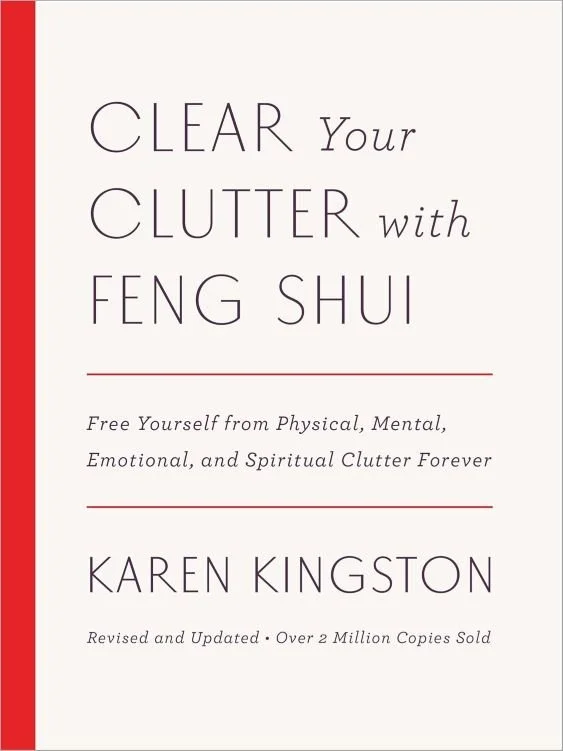
Here is an excerpt: “You are energetically connected to everything you own. When your home is filled with things that you love or use well, it becomes an incredible source of support and nourishment for you. Clutter, on the other hand, drags your energy down and the longer you keep it, the more it will affect you.” The author also talks about the fact that clutter takes up a lot of mental energy, even as your subconscious mind tries to suppress it, and so you feel more energetic with less clutter – that is definitely something I have seen with clients, and I talk about it often on social media!
Karen Kingston goes on to define four categories of clutter: things you do not use or love, things that are untidy or disorganized, too many things in too small a space, and anything unfinished. It’s an interesting way to categorize it! The first category clearly overlaps with core tenets of the KonMari Method™. I certainly agree that things that are messy come across as clutter (even if they can be put away easily), and I’m a big believer in the container concept – meaning that the size of your space tends to dictate how many things you can comfortably keep. As for unfinished projects, they are one category that I always name as a source of clutter! I think I would add categories such as things that bring back bad memories, things that are tied to decisions you have been putting off, etc.
(On a side note, I strongly believe in the importance of choosing objects that you love. For example, you might have a kettle that you use frequently, but you don’t really like it – maybe it’s ugly, or water doesn’t pour out of it properly, whatever the reason. I encourage you to invest a bit more and buy a kettle that you love! Loving your everyday objects truly elevates your experience and makes you happier overall.)

This image was created by Klub Boks for Pexels.
In this book, the author also talked about bagua, or the concept of specific areas of a room or home being associated with aspects of your life such as health, prosperity, or relationships. The more cluttered a specific physical area is, the worse you will be doing in that figurative area in your life. According to this theory, the rear left corner of a room would be associated with knowledge. My instinct is to say that’s woo. And yet, I now realize that in my home office, that is precisely where I keep my bookcase of reference materials and dictionaries! I feel like this is something I’d like to experiment with, maybe by making the “travel” area of my home super inviting!
Have any of you thought about the relationship between feng shui and clutter?

Hi there! I’m Amélie, a professional home organizer in San Antonio, Texas. I help people like you declutter their home, organize their belongings, and simplify their life. I love cleaning out a closet and removing a carload of donations from a home! My goal is to help you create a functional space that will make your life easier and more peaceful.
Interested? Check out my personalized services or book your complimentary consultation!
Back to school!
For many of us, this fall is the return to normal we had been waiting for. Schools in Texas are open for in-person learning, and there is no longer an option for remote learning. The downside is that, at least when I write these lines, my school district has decided NOT to enforce mask-wearing or social distancing, despite the recommendations from the AAP, the WHO and the CDC…
If you choose to make mask-wearing a part of your (and your child’s) routine, you’ll need to buy enough spare ones for your needs. It might be one or more per person per day, plus a few extras in case one is lost, a mesh bag to wash them safely, and designated spots for the clean and dirty masks. For my children, I put labels with their name in each mask (I like the ones from Name Bubbles for clothing). Your supply may need to be replenished if last year’s masks are too worn.

This photo was taken by Jessica Lewis for Unsplash.
As for organizing the space in your home, you’ll need a place for your kids to do homework. Hopefully most of the kinks were ironed out last year during remote learning! In any case, it’s important for a child to have a dedicated place to work. It doesn’t even have to be a desk – some kids will do fine at the dining room table, while others might be more comfortable in the living room (as long as the television isn’t on). Essentially, they need someplace to sit (or stand, for the more fidgety kids) without distractions so they can work. Headphones can help cut out noise if that is really an issue. Younger kids will benefit from being close to a caregiver who can help explain instructions or redirect their attention, but older kids are typically more autonomous. Consider a rolling tiered cart to corral school and art supplies; it’ll keep them handy while also allowing you to wheel them away when the kids are done. I also recommend supply caddies and sturdy magazine holders.
You might also need to streamline your entryway. There will now be more shoes, backpacks, lunchboxes, sports equipment, etc., to deal with, and you don’t want it all piling up in one place – or worse, all over the place! In our house, we limit the number of shoes any one person can keep near the door (spares go in their bedroom closet). It’s also helpful to have a designated spot for anything coming in or going out: for example, your child should know where to drop her backpack when she comes home from school, when to give you her agenda to sign, where to put sports gear… For the latter, uniforms need to be washed, so the laundry room makes sense, but other equipment might be better off in the garage until the next practice. Designate the place, then communicate it so that all members of the household are on the same page.

This photo was taken by Natasha Hall for Unsplash.
It’s also important to set up a weekly/monthly schedule and to keep it posted where family members can see it – I recommend a paper copy for your family command center and a digital copy with clickable links for ease of use from any electronic device. Free apps like Google Calendar or Cozi allow you to synch schedules for all family members. Cozi even has a grocery list that you can update in real time from any device!