
Storing socks
This isn’t a real blog post. It’s an inevitable follow-up to my post about simplifying. I want to address a question I get from friends and clients alike, about how to store socks. Can you fold them in such a way that they will stay together? Is it okay to roll them one onto the other or to tie them together? As is the case with many such organizing questions, my answer is: It depends.
The first thing to take into consideration is how you wash and dry your socks. Personally, I do not use the dryer on my clothes (linens, yes, but clothes, no). So once I have clean but damp socks, I smooth them out and hang them on a clothing rack to dry. This means that they dry in a nice, smooth shape, and are then very “docile” about being folded and staying that way.
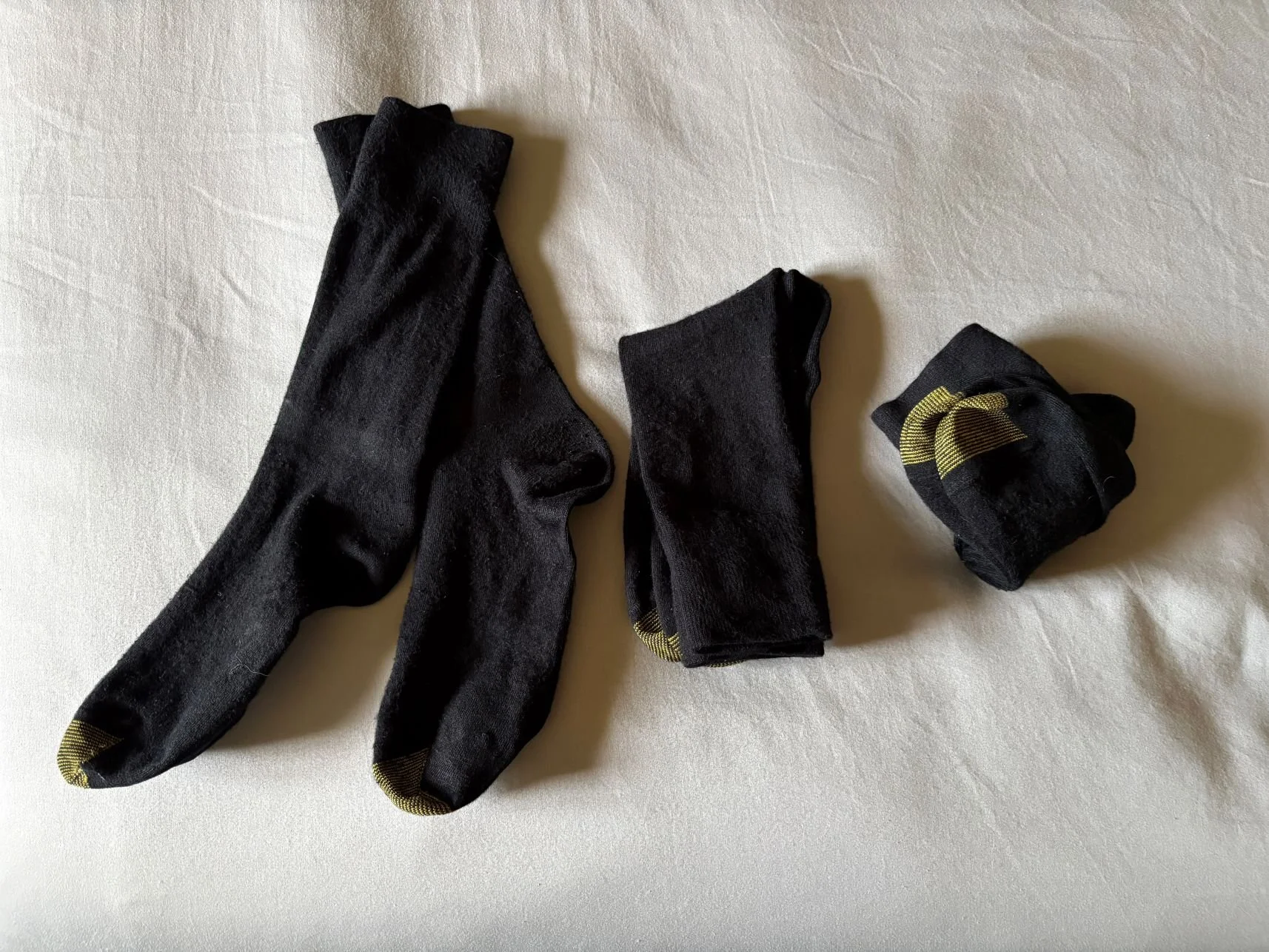
Am I saying that this is how you must wash socks? NO! Many people do not have the time or inclination to hang their clothes to dry and they much prefer using a dryer. That’s fine, but it does mean that your socks will dry with a more crooked or unpredictable shape, so they will be much harder to fold and may not stay neatly folded no matter how hard you try – you’re not doing anything wrong, you just can’t achieve the same results with socks that have been in the dryer. This is the case with many of the homes in which I work, and in those cases, I will “potato” the socks, meaning fold the top of one over the other to keep the pair together in the drawer. (I do not recommend tying them together at all.)
To be clear, the downside of this method is that it causes more strain on the elastic, making the socks break down more quickly. Plus, fabric will take the shape it had when it was drying, so with this method, it is possible that the socks will be less comfortable. Folding is the ideal way to store socks, but I do understand that it is not possible for everyone.
Bottom line: If the way you are currently washing and storing socks works for you, keep doing it. If there is something you would like to improve, let’s figure out how to tweak your system so that it works for you.
Bonus tips: If pairing socks is a pain point for you, try doing it mindlessly as you are watching television. Or have your kids do it! Another tip is to just get sets of matching socks and use a different one for each member of the household. Now the only question will be how to spend the extra time you’ll have!
Bonus bonus tip: Washing smaller loads and not using the dryer seem to be the keys to not ending up with orphaned socks.

Hi there! I’m Amélie, a professional home organizer in San Antonio, Texas. I help people like you declutter their home, organize their belongings, and simplify their life. I love cleaning out a closet and removing a carload of donations from a home! My goal is to help you create a functional space that will make your life easier and more peaceful.
Interested? Check out my personalized services or book your complimentary consultation!
Do we really have 300,000 items in our homes?
You’ve probably heard that number being floated around: the average household contains 300,000 items. But does it really? It turns out I have a bit of inside information, as well as some thoughts, so here we go!
That number actually comes from a NAPO colleague of mine, Regina Lark, who was quoted in the LA Times in 2014 saying that the average house contains 300,000 items. I attended one of her webinars last month, where she explained that when asked, she said that she got the number from the UCLA’s 2012 book Life at Home in the Twenty-First Century – which I happened to be reading at the time! And then, try as she might, she was never able to find that reference, although she is convinced that she did read that number somewhere and did not make it up. I also could have sworn that it was in that book, but when I looked for it, I couldn’t find that figure either. However, her quote has since taken on a life of its own and is, to this day, being repeated everywhere as truth, probably because the LA Times is an important publication.
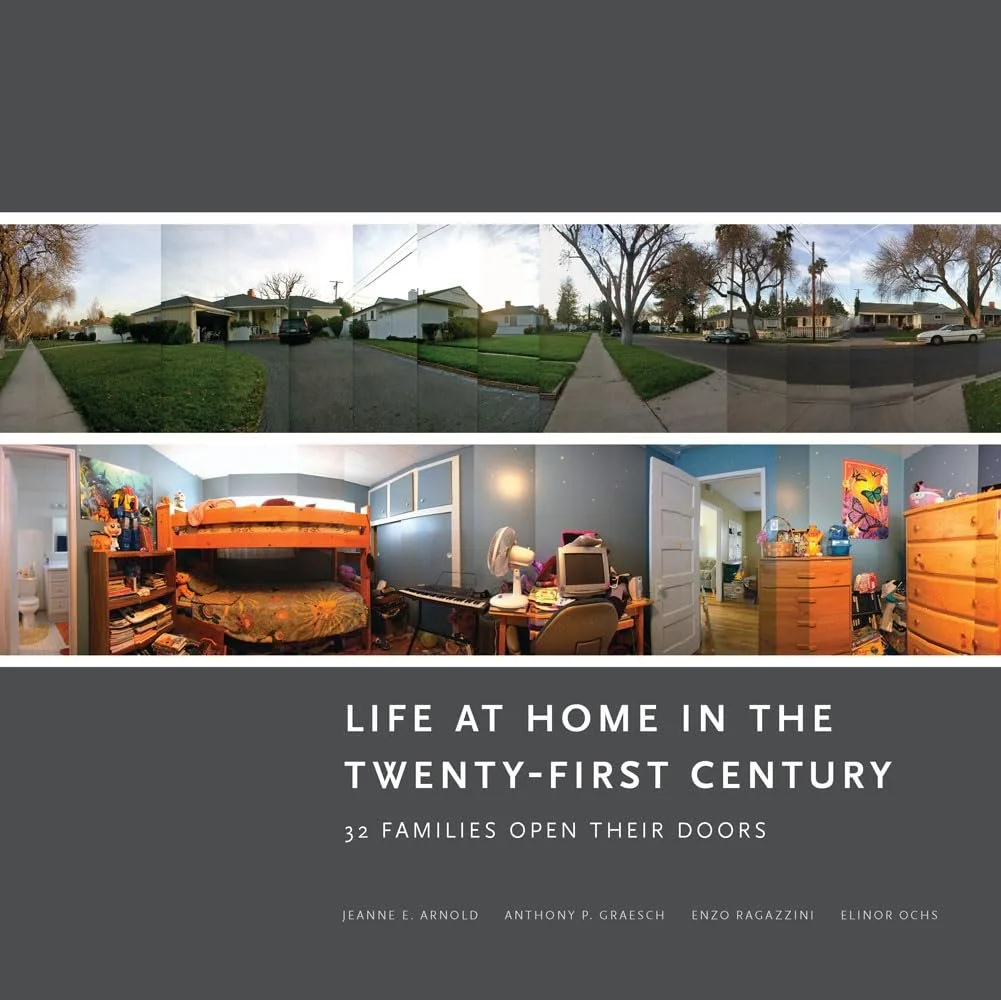
So, the book was published after UCLA conducted a great anthropological study with 32 American families in 2012, and they talk a lot about their methodology. They did count objects, but it was more of an estimate: they made educated guesses about certain groups of items, and they only ever counted items in plain sight – meaning that anything that would have been in a drawer, in a cabinet, or behind something visible was not counted. Here are some figures from that study, along with a quote that will not surprise you: “Middle-class America has the most possessions per family in history.” Households surveyed had an average of 438 books and magazines, 139 toys, and 39 pairs of shoes per family (again, these are only visible items). In home offices, the lowest number of plainly visible non-paper objects was 21, and the most was 2,337. In the garage, it ranged from 50 to 650. Having more items on one’s refrigerator (magnets, papers, etc.) was correlated with having more objects in the home. But there is no total anywhere in sight!
Now, here’s where my opinion comes into play. Let’s be generous by rounding up and saying that a person lives for 30,000 days. From those days, we wouldn’t really count childhood, so there’s maybe 25,000 days left? Let’s say the average household has two adults, and they are acquiring objects not just for themselves, but also for their 2.5 kids. Okay. So with my rough mathematical model here, those adults would have to acquire (while never discarding!) about 12 items each day in order to have 300,000 by the end of their life, right? So it would have to be an even faster rate of acquisition in order to have that many items while their kids are still living with them, as in the UCLA study. I’m not counting perishable items like groceries or cleaning products in this tally, and I wouldn’t be counting every last piece of paper either, since the UCLA anthropologists didn’t.
Speaking for my household, we are not acquiring items at nearly that rate. Sure, there are isolated times when I will buy a lot at once. For example, in one shopping spree, I could buy several outfits for my kids to go back to school as they grow, along with school supplies. But on an average day, I am not buying anything. And regardless of how much I buy, I do get rid of some items along the way (like the kids’ clothes that have been outgrown, plus the school supplies that get used up).
All this to say that while I do not have any idea how many items are in my household, and while I’m sure the number would seem very large if I were to learn it, I don’t think it’s anywhere close to 300,000!
Hi there! I’m Amélie, a professional home organizer in San Antonio, Texas. I help people like you declutter their home, organize their belongings, and simplify their life. I love cleaning out a closet and removing a carload of donations from a home! My goal is to help you create a functional space that will make your life easier and more peaceful.
Interested? Check out my personalized services or book your complimentary consultation!
The Joy of Domesticity
I came across this New York Times article about South Korean women making videos on the joy of domesticity, mainly cooking and cleaning tasks. It’s not about organizing per se, but it falls at the crossroads between “hygge” and “spark joy,” which is my territory.
There were many similarities between the various videos, but let’s take Vlog that makes you want to clean by Ms. Kim Sang-mi (a.k.a. Haegreendal) as an example. According to the article, she is “one of many South Korean female creators who have carved out a genre of aspirational videos on YouTube that show the simple pleasures of keeping a clean, organized and food-filled home.”
The first thing that I noticed, besides how popular these videos are (often millions of views; 4.85M for the one I linked to above), is the particular aesthetic. Not just the fact that these videos look professionally made, but that they are incredibly soothing. It’s not the domestic aspects; it’s the tone, the unhurried tasks, the casual shuffle of slippered feet, the abundant light, the air, the minimalist and ecofriendly simplicity, the calm and quiet (kids are rarely present for the video, even when they are in the house, and the videos have subtitles instead of voice-overs). The vloggers often remain anonymous, choosing to appear on camera only from behind or in close-ups of their hands or lower limbs. These videos are about slowing down and awakening the senses; the video itself is a form of meditation. The article said that “mundane activities like cooking and cleaning [are] given a cinematic treatment,” which hits the nail on the head.
The pitfall is that these videos reinforce traditional gender roles (but even though specific things like that division of labor don’t work for me, they might still work for someone else, obviously). Moreover, these videos can make it seem like that’s all that the protagonist does all day, and only when you listen closely do you realize that, in Ms. Kim’s case, she had to complete a contract with a tight deadline that day (she’s a freelance illustrator working from home); but that is never shown. She may also be monetizing her online presence, and honestly, good on her if she does.
Even though some videos can sound prescriptive (see The orders for living a wise day), they are never dogmatic. The domesticity is interspersed with nuggets of wisdom, like “Even if you are somebody’s wife and mother, don’t give up on your own happiness.” It seems to present self-care as found in domesticity itself.
I couldn’t help but compare this to videos made by women in North America. There are videos like this one by duo SisLetters, two Korean sisters who live in the U.S., and it does stick to the same genre as above. Other American videos are radically different, though. I started with another vlogger referenced in the article, Ebony Nikita Okeke (a Dominican living in Atlanta). She posts things like Day in the life of a young housewife, twice a week. Her videos are much less professional-looking; she is in front of the camera a lot, giving beauty tips and tutorials in addition to homemaking advice. She is also more into decorating and showing products in a way that feels consumeristic. With her, self-care is luxurious.
I followed up with A day in the life of a stay-at-home wife by Texan Tachae Blunt. Her videos are more descriptive of her day-to-day life instead of having special moments chosen for the camera, and she’s less “in your face” than the Atlanta vlogger but much more so than the South Korean ones.
The one that came the closest was Cynthia Loewen, from Canada, with videos like Planning, Clean with me, Homemaking, though she also discusses femininity and lifestyle. (I’d be remiss if I didn’t mention the Minimal Mom, Dawn from Minnesota: her videos are more professional and target the same market, but they’re not about domesticity in the same way that the South Korean ones are.)
In all cases, the American videos have a very different tone from the South Korean ones. American vloggers put themselves in the forefront and make videos that aim to be somewhat instructional. They can be very interesting and worth watching, of course, but are never soothing in the way that the South Korean ones are. I’m not even sure what this genre is called, but I’m really enjoying it!
I’ll leave you with a palate cleanser of bloopers for the South Korean-style videos, which seem that much funnier given the seriousness of the finished product!